Koh Samui's Beaches, and Why the Sea Is Not the Variable
Eight beaches on one island, measured rather than described. On Phuket the beach decides the sea; on Koh Samui it does not, and five of these eight share one identical set of figures. What actually separates them is which way they face and what is behind the sand.
Researched & fact-checked by our editors · Updated 29.08.2026
Every guide to Koh Samui’s beaches ranks them, and we set out to do the same thing. The measurements would not support it, and what they showed instead turned out to be more useful than a ranking.
This site measures wave height at each beach it covers, from four years of marine reanalysis on a grid of about five kilometres. On Phuket that grid separates the beaches cleanly: Mai Khao at the northern end averages 0.37 metres in February and Kata in the south averages 0.60, on the same island on the same day, and the ordering holds in every month of the year. There, the beach you choose genuinely decides the sea you get.
On Koh Samui it does not. Five of the island’s eight beaches, Chaweng, Bophut, Maenam, Choeng Mon and Silver Beach, fall inside a single grid cell. They do not merely have similar figures; they have identical ones, because the model cannot tell them apart. Only Lamai, Bang Por and Taling Ngam sit in cells of their own, and even those are close.
So what does separate them
Which way the beach faces, and what is behind the sand. Those are the two variables that do the work on this island, and they are the ones the cards below are organised by.
The aspect matters because the northeast monsoon arrives in November and blows through February, straight onto the east coast. The north coast is angled away from it and looks across at Koh Pha Ngan rather than at open water. The west coast faces the mainland entirely, which is why it has the sunsets and the softest water and a tide that goes out a very long way.
What is behind the sand matters more here than on almost any Thai island, because Samui is developed enough that the difference between two beaches ten minutes apart is the difference between forty restaurants and none.
The eight beaches
East coast
The developed side, facing the open Gulf and taking the northeast monsoon in December and January full on.
Chaweng
Faces east
The island's main event: seven kilometres of sand with everything behind it, and the wrong choice if that is not what you came for.
Behind the sand
A continuous strip of hotels, malls, bars and restaurants. Nothing needs arranging and nothing is quiet.
The water
Long, wide and swimmable, with a reef at the northern end that keeps the water flat and shallow there.
Wave height0.58m in January, 0.36m in July
Same 5km cell as Bophut, Maenam, Choeng Mon, Silver Beach, so the figures are identical rather
than merely similar.
Silver Beach
Faces east
A small cove between the two big strips, and the closest thing on the east coast to being away from them.
Behind the sand
Two resorts and very little else. Rocks close both ends, which is why it stays small.
The water
Clear, because the headlands keep the sand from moving. Good snorkelling by Samui standards, which is a low bar.
Wave height0.58m in January, 0.36m in July
Same 5km cell as Chaweng, Bophut, Maenam, Choeng Mon, so the figures are identical rather
than merely similar.
Lamai
Faces east
Chaweng's smaller, older and cheaper neighbour, with more sand per person and a shorter strip behind it.
Behind the sand
A working town rather than a resort strip, with a Sunday walking street and the island's second nightlife.
The water
Steeper than Chaweng and with more shore break, and the only beach on this coast whose measurement is its own rather than shared.
Wave height0.61m in January, 0.39m in July
North coast
Shallower, calmer and lower-rise, looking across at Koh Pha Ngan rather than at open water.
Choeng Mon
Faces northeast
A rounded bay at the northeast corner, and the one most families end up on without planning to.
Behind the sand
A handful of resorts and a short row of restaurants. You can walk to dinner and that is about the extent of it.
The water
Shallow a long way out, sheltered by the headland and by the island offshore you can wade to at low tide.
Wave height0.58m in January, 0.36m in July
Same 5km cell as Chaweng, Bophut, Maenam, Silver Beach, so the figures are identical rather
than merely similar.
Bophut
Faces north
Fisherman's Village: the best evening on the island, attached to a beach that is merely fine.
Behind the sand
Old wooden shophouses turned into restaurants and bars along one lane, and a Friday night market.
The water
Flat and shallow, with sand that is browner and coarser than the east coast. You come for the lane, not the swim.
Wave height0.58m in January, 0.36m in July
Same 5km cell as Chaweng, Maenam, Choeng Mon, Silver Beach, so the figures are identical rather
than merely similar.
Maenam
Faces north
Five kilometres of low-rise quiet, and the answer for anyone who found Chaweng and Bophut too busy.
Behind the sand
Almost nothing: a scattering of small resorts, a village, and long gaps between them.
The water
Shallow and calm, with Koh Pha Ngan across the channel and the ferry pier at the eastern end.
Wave height0.58m in January, 0.36m in July
Same 5km cell as Chaweng, Bophut, Choeng Mon, Silver Beach, so the figures are identical rather
than merely similar.
Bang Por
Faces north
The northwest corner, where the island stops being a resort and turns back into a coast.
Behind the sand
The ring road, a line of local seafood places on stilts, and very little accommodation.
The water
The calmest measurement on the island, and a shelf so shallow and so long that at low tide swimming is not on offer.
Wave height0.45m in January, 0.36m in July
West and south
Facing the mainland. The sunsets are here, and so is the tide that goes a long way out.
Taling Ngam
Faces west
The west coast: the island's best sunsets, its softest water and its longest drive to anywhere else.
Behind the sand
A few high-end resorts on the hillside and nothing walkable. This is a stay-put beach.
The water
Soft, warm and often glassy, looking out at the Five Islands. The tide goes out a very long way.
Wave height0.53m in January, 0.38m in July
Wave height is open-meteo marine reanalysis, 2022 to 2025, read at each beach and given as the mean of the daily maximum for
that calendar month. January and July are quoted because they are this coast's roughest and one
of its calmest, which is the reverse of the Andaman. Aspect is read off the map, not computed,
and it is what explains the numbers. The full month-by-month series for both coasts is on
the island's weather page.
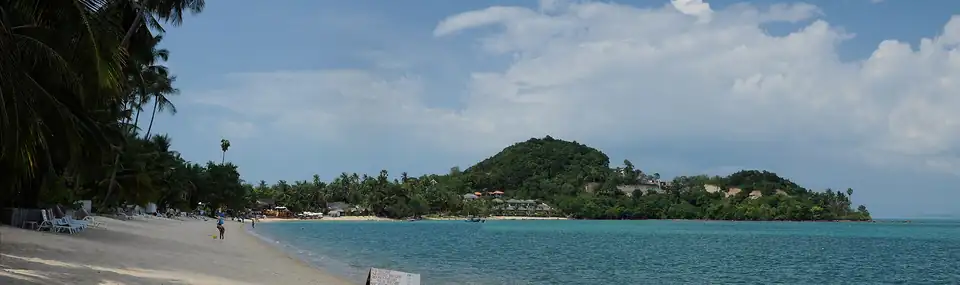
Choeng Mon: a rounded bay at the northeast corner, shallow a long way out and sheltered at both ends. Photo: tomtr on Pixabay
Reading the numbers honestly
Three limits, all of them worth knowing before you quote a figure from this page at anyone.
The archive starts in 2022. Four years is a short climatology, and nothing like the thirty years behind the rainfall on our weather page. It is what exists.
The grid is about five kilometres. That is the shared-cell problem above, and it is disclosed on every card it affects rather than quietly smoothed over. A page that ranked these five beaches by calmness would be inventing a precision the source does not have.
This is modelled sea state, not surf at the shoreline. A sandbar, a reef or a headland can make a beach calmer or rougher than its cell suggests. Chaweng’s northern end sits behind a reef and is noticeably flatter than the rest of the same beach, and no grid of this size will ever show that.
The tide is the thing nobody mentions
If there is one practical fact about Samui’s beaches that the brochures leave out, it is not the waves. It is how far the water goes out.
The north and west coasts sit on long shallow shelves. At Bang Por and along Taling Ngam, low tide can put the waterline a considerable distance from where you left your towel, and swimming stops being on offer for part of the day. This is not a defect, and at Maenam it is exactly why the beach is good for small children, but it does mean the beach you looked at in a photograph taken at high tide is a different place six hours later.
The east coast at Chaweng and Lamai has a smaller tidal range and is the more reliable choice if being able to swim whenever you feel like it matters to you.
Choosing, in one paragraph
Stay at Chaweng if you want the island’s full menu within walking distance and you are untroubled by the volume. Lamai for the same idea with fewer people and lower prices. Bophut for the best evening on Samui, on the understanding that the beach is not why you are there. Choeng Mon or Maenam for a quiet bay you can still eat near. Silver Beach for a small cove between the two big strips. Bang Por or Taling Ngam if you have a car or intend never to leave the resort, and want the island as it was before the ring road filled in.
Where to actually book on each of them is on our where to stay page, and what to do once the beach has worn thin is on things to do.
Koh Samui's Beaches, and Why the Sea Is Not the Variable FAQs
Which is the best beach in Koh Samui?+
Chaweng if you want everything within walking distance and do not mind the volume, Bophut if you want the best evening on the island, Maenam if you want quiet with a shop and a restaurant still in reach, and Taling Ngam if you intend to stay put and watch the sunset. There is no single answer here because, unusually, the sea is much the same at all of them.
Which Koh Samui beach has the calmest water?+
Bang Por on the northwest corner, at 0.45 metres in January against 0.61 at Lamai. But the honest answer is that the difference is small: five of the island's eight measured beaches fall inside one 5km marine cell and carry identical figures. On Koh Samui the month changes the sea far more than the beach does.
Is Chaweng or Lamai better?+
Chaweng has the longer beach, the better swimming and everything else; Lamai has more sand per person, lower prices and a shorter strip. Lamai is also the one east-coast beach with its own measurement rather than a shared one, and it runs slightly rougher with more shore break.
Which Koh Samui beach is best for families?+
Choeng Mon or Maenam. Choeng Mon is a rounded bay sheltered by a headland and shallow a long way out, with a short row of restaurants behind it. Maenam is longer, quieter and just as shallow. Avoid the west coast with small children at low tide, when the water retreats a very long way.
Are Koh Samui's beaches sandy or rocky?+
Sandy, but the sand changes noticeably around the island. The east coast at Chaweng and Silver Beach is the whitest and finest, the north coast at Bophut and Bang Por is browner and coarser, and the west coast is softer and shallower with a much bigger tidal range.
Google Analytics is the only optional thing here, and it is not ours: it
tells us which guides get read, and it sets its own cookies. It does not
load until you decide, and refusing changes nothing about the site.
Read our privacy policy.