About Thailand
Religion in Thailand
Thailand is one of the most Buddhist countries on earth by proportion, and the form it takes is Theravada, the older and more monastic of Buddhism's two great traditions. But the visible religion of daily life is broader than that: the shrine outside every building is older than Buddhism in this region, and in four provinces on the Malaysian border the majority faith is Islam.
Thailand's 2018 census.
Theravada, and what it looks like from the street
Theravada Buddhism keeps the monastic order at its centre, which is why Thailand has somewhere over forty thousand temples and why a saffron robe is an ordinary sight rather than a remarkable one. Most Thai men ordain at some point, often briefly, and the temple remains the social centre of a village in a way a church largely no longer is in Europe.
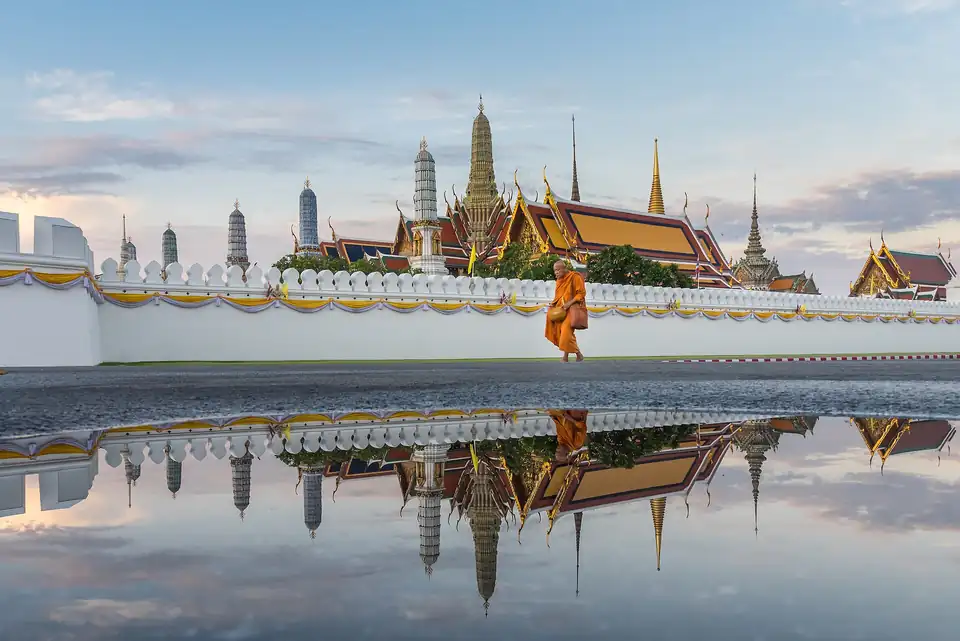
The visible rhythm is the alms round. Monks walk out shortly after dawn with a bowl, and people kneel at the roadside to put food in it. What is happening is not charity in one direction: the giver is making merit, and the monk is providing the occasion. Watching is fine. Photographing from a distance is fine. Standing over a kneeling person with a phone is not.
The spirit house on every plot
Outside almost every building in Thailand, from a village shophouse to a Bangkok skyscraper, there is a small shrine on a post with flowers, incense, a red drink and sometimes a set of tiny figures. This is a san phra phum, a house for the spirit of the land the building displaced.
It is not Buddhist. Animist belief in this region is older than Buddhism and was never replaced by it, and the two run alongside each other without much friction. The practical point for a visitor is simply that it is a shrine: do not lean on it, do not put a drink on it, and do not move the offerings for a photograph.
Islam, and the south
Islam is the second religion of Thailand at 5.4% of the population, and its distribution is the thing worth knowing. Nationally it is a small minority; in the four provinces on the Malaysian border, Pattani, Yala, Narathiwat and Satun, it is the majority faith and the first language of most people is Malay rather than Thai.
Its influence reaches further than that in one respect a visitor meets daily, which is the food. Massaman curry, the roti stalls of the south and much of the grilled seafood tradition on the Andaman coast come from that Muslim and Malay side of the country's cooking. Thai food by region
The monarchy
The king is constitutionally required to be a Buddhist and is the patron of the faith, and the monarchy occupies a place in Thai public life with no real European equivalent. Portraits of the king hang in shops, offices and homes, and are treated with genuine seriousness.
Thailand also has a lèse-majesté law, under which insulting the monarchy is a criminal offence carrying a prison sentence, and it applies to foreigners. There is nothing a visitor needs to do about this beyond the obvious: it is not a subject for a casual opinion in public, and a banknote, which carries the king's image, is not something to step on.
The religious year moves
Almost every Buddhist holiday in Thailand falls on a full moon of the lunar calendar, so its Gregorian date changes each year. Several are public holidays and alcohol sales stop on them, which catches people out. These are the ones that change what a trip looks like.
-
Makha Bucha
February or March, on the full moon date moves
A public holiday. Temples hold candlelit processions after dark and alcohol sales stop for the day.
Thailand in February -
Visakha Bucha
May, on the full moon date moves
The most important day in the Buddhist calendar and a public holiday. Alcohol sales stop.
Thailand in May -
Asalha Puja and Khao Phansa
July, on the full moon and the day after date moves
The start of the three-month Buddhist Lent. Two public holidays and no alcohol sales on either.
Thailand in July -
Phuket Vegetarian Festival
Late September or October, over nine days date moves
Set by the Chinese lunar calendar. Processions, street food and body-piercing rituals at the Chinese shrines.
Thailand in September -
Ok Phansa
October, on the full moon date moves
The end of Buddhist Lent, and the start of the merit-making season that follows it.
Thailand in October -
Phuket Vegetarian Festival
Late September or October, over nine days date moves
Thailand in October -
Loy Krathong and Yi Peng
November, on the full moon date moves
Floating lanterns on the water everywhere, and sky lanterns in Chiang Mai. The dates move each year and Chiang Mai sells out months ahead.
Thailand in November
Going into a temple? Shoulders and knees covered, shoes off, and never turn your back on a Buddha image for a photograph. The full guide to temple etiquette
Frequently asked questions
What is the main religion in Thailand?+
Theravada Buddhism. The 2018 census put it at 93.5% of the population, which makes Thailand one of the most Buddhist countries in the world by proportion.
Is Thailand a Buddhist country officially?+
In practice rather than in law. The constitution does not name a state religion, but it requires the king to be a Buddhist and obliges the state to patronise and protect Buddhism. Buddhist holy days are public holidays and alcohol sales stop on them.
What are the spirit houses outside Thai buildings?+
San phra phum, shrines for the spirit of the land the building stands on. They predate Buddhism in the region and coexist with it quite comfortably. You will see one outside almost every house, shop, hotel and office in the country, usually with fresh offerings.
Can women touch monks in Thailand?+
No. A monk may not be touched by a woman, and passing something to him directly is avoided; the item is set down or passed through a man or a cloth. This is a monastic rule rather than a judgement, and monks will step aside on a bus or in a queue to keep the distance.
What should I wear to a Thai temple?+
Shoulders and knees covered, for everyone. Shoes come off before you enter a building, and often before the steps. Some major temples lend or rent a sarong at the gate, and many do not.
More about the country: the language, the people, the flag.