
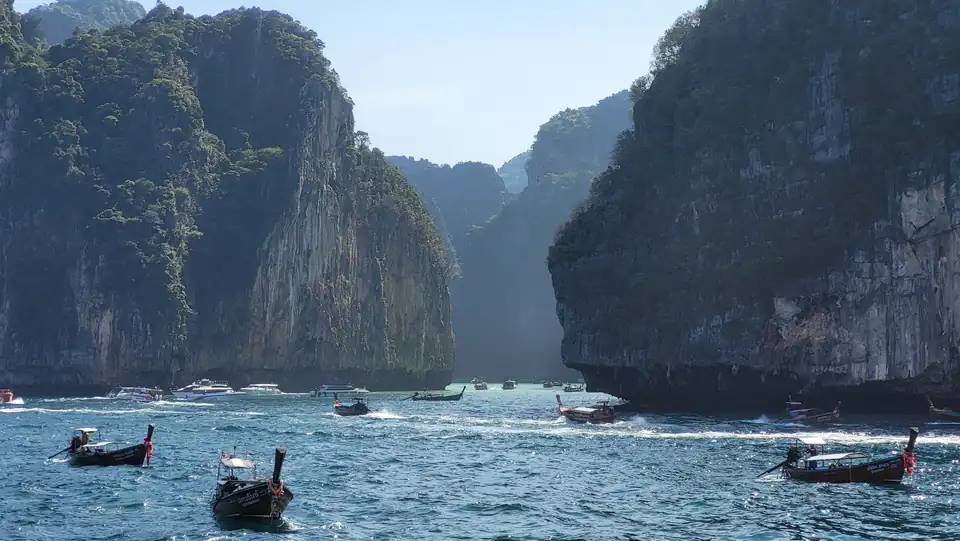
Koh Phi Phi · Andaman Coast
Koh Phi Phi Travel Guide
Phi Phi is two islands: a party village on an isthmus between two bays, and an uninhabited limestone sister next door holding Maya Bay. The water is the best on this coast and the peace is the worst, and the difference between a good trip here and a bad one is almost entirely about where on the island you sleep.
- Driest months
- December to March 4 months under 150mm, 15 rain days or fewer
- Best for
- The scenery, if you can take the crowds
- Airport
- Krabi (KBV) or Phuket (HKT), then a ferry
- Getting around
- On foot and by long-tail. No cars at all
Phi Phi is two islands and they could hardly be less alike. Phi Phi Don is the inhabited one: a butterfly of limestone with a flat sandy isthmus between its two wings, and the entire village built on that isthmus. Phi Phi Leh, twenty minutes south, has nobody on it at all and holds Maya Bay.
The scenery is the best on this coast and it is not close. So is the noise. Almost everything written about whether you will enjoy Phi Phi comes down to which of those two facts your trip is arranged around.
The isthmus problem
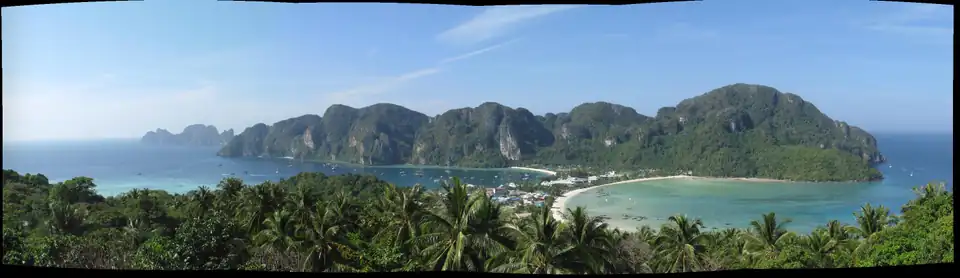
Everything that is difficult about Phi Phi follows from its shape. The village sits on a strip of flat sand a few hundred metres wide with Tonsai Bay on the south side, where every ferry lands, and Loh Dalum on the north, a shallow crescent that empties almost entirely at low tide. Bars line both. There are no cars, which sounds peaceful and means there is no traffic noise to mask anything.
The result is that sound carries across the whole settled part of the island, and it carries until two or three in the morning. This is not a complaint about Phi Phi; it is what the island is, and a great many people come precisely for it. It is a problem only for the people who booked the scenery and got the isthmus.
Long Beach, about twenty minutes southeast on foot or a few minutes by long-tail, is the standard answer: the same water, a fraction of the volume, and a walk home in the dark or a boat. The resorts in the northern bays, Loh Bagao and Laem Tong, are quieter still and are effectively self-contained, which is either the point or the drawback depending on the traveller.
Maya Bay, and what actually changed
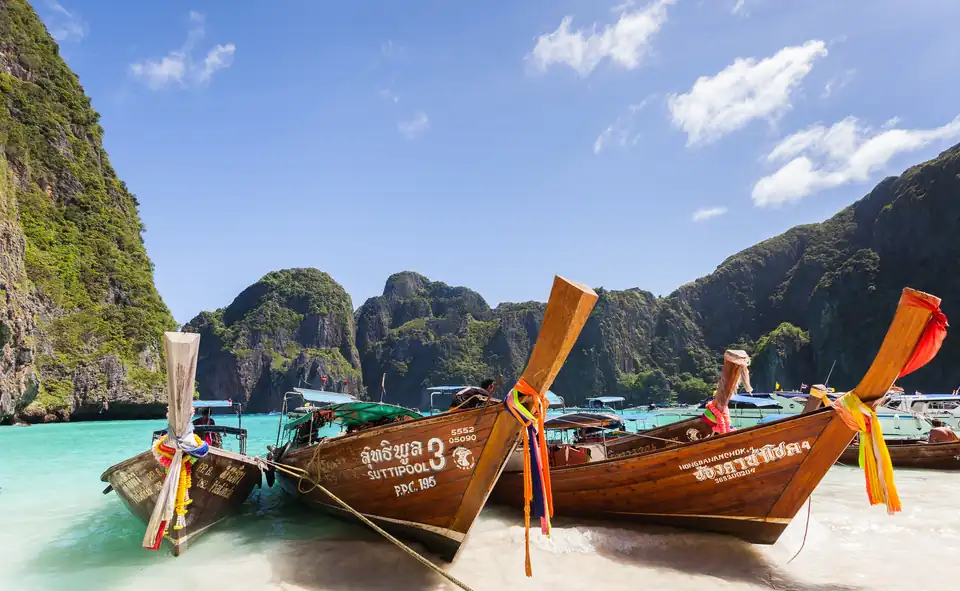
Maya Bay is on Phi Phi Leh, it is the cove from the 2000 film, and by 2018 it was taking thousands of visitors a day with the boat fleet anchoring in the bay. It was closed in June 2018 so the reef could recover, and stayed closed for more than three years.
It reopened on 1 January 2022, and it works differently now. Boats no longer enter or land in the bay: they dock at Loh Samah on the far side of the island and visitors walk about five minutes over a boardwalk to come out onto the beach from behind. Numbers are capped and visits are timed. It closes every year for August and September to rest.
The recovery is real and is the most encouraging conservation story on this coast: blacktip reef sharks are back in the bay in numbers, and coral replanted during the closure has taken.
The specific rules have changed more than once since 2022, including whether and where you may swim, so we publish no current rule list. Ask the operator on the day you book. What is stable is the shape of it: you arrive from behind, you do not land on the sand from a boat, and you do not have the place to yourself.
The sea, and why we will not rank the beaches
Phi Phi Don is small enough to sit inside a single cell of the marine model we use, about five kilometres across. Tonsai, Loh Dalum and Long Beach therefore come back with identical numbers, and any page ranking them by sea state is ranking noise.
What the measurement does support is the island as a whole: between 0.37 metres in April and 0.89 metres in July and September, which is a calm coast by Andaman standards and about two-thirds of what Phuket’s west side takes in the same months. The reason is the shelter of the limestone and the position behind the larger islands, and it is why the water here looks the way it does.
Beaches are compared individually, where the grid allows it, on the beaches page.
The year
- Rainfall, millimetres per month
- Phuket, for comparison
Driest is February at 25mm over 5 rain days, wettest is October at 297mm over 28 rain days. Against Phuket, Koh Phi Phi is drier in every month of the twelve, by most in May.
Phi Phi is drier than Phuket in every month of the year, by most in May, and it is otherwise the same coast on the same calendar: November to April, with February at 25mm the driest month of its year, and a monsoon from May to October that peaks at 297mm in October. The ferries thin out in the monsoon and some of the smaller places close.
What there is to do
The list is short and that is honest rather than dismissive.
The boat trip around Phi Phi Leh is the day everyone comes for: Maya Bay, Pileh Lagoon, Viking Cave and the snorkelling at Bamboo Island. Book the early one. The difference between a boat that leaves at seven and one that leaves at ten is the difference between the trip in the photographs and the trip in the queue.
The viewpoint above the village is a steep twenty to thirty minutes of steps and gives you the picture of the two bays and the isthmus that is the island’s other famous image. Go for sunrise if you can manage it, which on Phi Phi is a realistic ask only if you did not go out.
Diving and snorkelling are good and cheap, with Bida Nok and Bida Nai just south of Phi Phi Leh among the better sites on this coast. It is not the Similans, and it is a fraction of the effort.
The tsunami, and the village
The isthmus is a few metres above sea level with a bay on each side, and in December 2004 the wave came in from both. The village was destroyed and a great many people died. What stands now was rebuilt afterwards, which is worth knowing when you look at how densely it is built and how close to the water.
Getting here
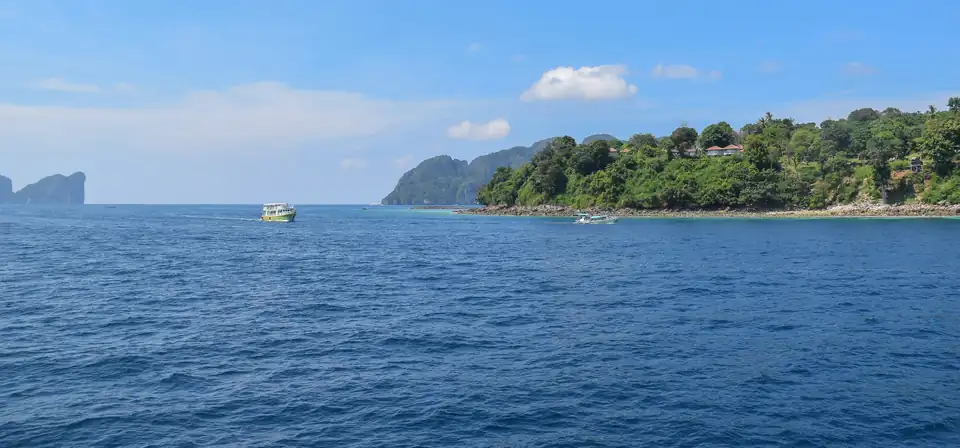
Ferry only. From Krabi it is about ninety minutes to two hours; from Phuket about two hours by ferry or one by speedboat. Both run several times a day in season and thin out in the monsoon, and both land at the same pier in Tonsai Bay, a few minutes’ walk from the middle of the village.
There are no cars on the island and no roads for them, so bring luggage you can carry or wheel over sand. The real timings are on Krabi to Koh Phi Phi and Phuket to Koh Phi Phi.
Phi Phi, Lanta or Lipe
These three are the Andaman’s small-island choices and they are not interchangeable.
Phi Phi for the scenery, if you accept the crowds and either want the nightlife or will stay away from it. Lanta for a quiet week with a scooter and somewhere to eat every night; it is the one to book if Phi Phi sounds exhausting. Lipe for the clearest water in the country, at the cost of a much longer journey.
Where they all sit against the Gulf islands, month by month, is on the islands overview.
Why this guide has no sub-pages
Because the searches are not there. “Koh Phi Phi” draws about 2,850 a month in Britain across every phrasing, at a difficulty of 51, which is the hardest head term of any island on this site and about a fifth of what Koh Lanta draws at a difficulty of nothing. Splitting that into a weather page and a where-to-stay page would produce three thin pages competing with each other for one query.
Getting here has its own route pages already, from Krabi and from Phuket, with the real timings on them.
Getting to and from Koh Phi Phi
Times, how often each runs, and what it costs, for every route we have checked.
Koh Phi Phi FAQs
Is Koh Phi Phi worth visiting?+
For the landscape, yes, and it is genuinely among the best in Thailand. For quiet, no. Phi Phi Don's village sits on a narrow isthmus with bars either side and no cars to drown them out, and the day-boat fleet arrives every morning. Where you sleep decides which island you experience.
Is Maya Bay open?+
Yes, since 1 January 2022, after being closed from June 2018 for the reef to recover. It closes again every year for August and September. Boats no longer land on the beach: they dock at Loh Samah on the back of the island and you walk about five minutes over a boardwalk.
Where should you stay on Koh Phi Phi?+
Away from the isthmus if you want to sleep. Tonsai and Loh Dalum are the two bays either side of the village and both are loud until late; Long Beach, about twenty minutes away on foot or by long-tail, is the usual compromise, and the resorts in the island's northern bays are quiet and effectively cut off.
Which Phi Phi beach has the calmest sea?+
We cannot tell you, and we would rather say so. The whole of Phi Phi Don falls inside one 5km cell of the marine model, so Tonsai, Loh Dalum and Long Beach return an identical figure. What the model does say is the island as a whole: 0.37 metres in April against 0.89 in July and September.
How do you get to Koh Phi Phi?+
By ferry only, and there is no airport. From Krabi it is about ninety minutes to two hours, from Phuket about two hours by ferry or one by speedboat. Both run several times a day in season and thin out in the monsoon.
How many nights on Koh Phi Phi?+
Two, for most people. That is one full day for the boat trip round Phi Phi Leh and Maya Bay and one for the viewpoint and a beach, which is the island's whole list. People who came for the nightlife stay longer and people who came for quiet wish they had gone to Lanta.
Are there cars on Koh Phi Phi?+
None. There are no roads capable of taking one. Everything moves on foot, by long-tail boat or on the push carts that supply the village, which is a large part of the island's charm and the reason luggage is a genuine consideration.
 Bangkok
  Chiang Mai
  Phuket
  Krabi
Krabi  Koh Samui
  Khao Lak
  Chiang Rai
  Pai
Pai  Ayutthaya
  Sukhothai
  Koh Phangan
  Koh Tao
  Trat
Trat  Koh Mak
  Koh Kood
  Koh Chang
  Koh Samet
  The Similan Islands
  Pattaya
  Koh Lanta
  Koh Lipe
  Thailand Islands