
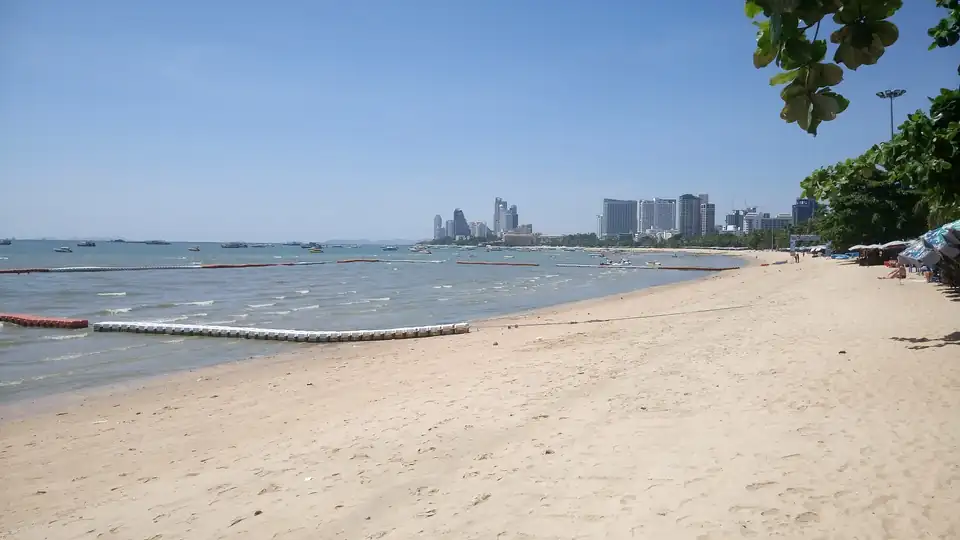
Pattaya · Central Thailand
Pattaya Travel Guide
Pattaya is a city of a hundred thousand people on the Gulf, two hours from Bangkok, with a reputation that belongs to one street of it and three beaches that are three different holidays. It is also the driest and among the calmest of every beach destination on this site, which is the part nobody mentions.
- Driest months
- November to April 6 months under 150mm, 15 rain days or fewer
- Best for
- The driest beach weather in the country, an hour and a half from Suvarnabhumi
- Airport
- Suvarnabhumi, then about 90 minutes by road
- Getting around
- Songthaew along the beach roads, and taxis between the three beaches
Pattaya is a city of about a hundred thousand people in Chonburi province, on Thailand’s eastern seaboard, about 145 kilometres by road southeast of Bangkok, and around 120 from Suvarnabhumi airport. It faces west across the upper Gulf, which is the first useful thing to know about it: the sun sets over the water here rather than behind the hills, as it does on Koh Samui and Koh Chang. It also has an international reputation that is both accurate and badly scaled. The reputation belongs to one pedestrianised street at the southern end of one of its three beaches. The other two beaches are four and eight kilometres away from it and have very little to do with it.
That is the whole practical content of this page, and the rest of it is the detail: which of the three, and when.
The reputation, stated once
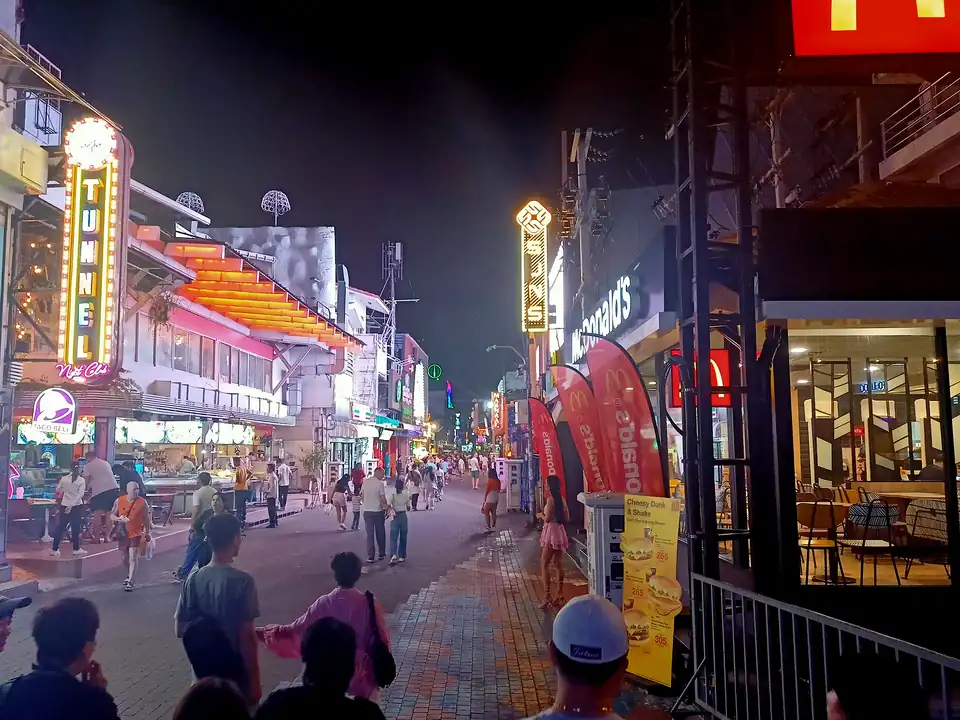
Pattaya grew as a rest destination for American forces during the Vietnam war and the industry that arrived with them stayed after they left. Walking Street, running from the south end of Beach Road down to Bali Hai pier, is what that turned into, and it is what the city is known for abroad.
It is not hidden, it is not something you need to avoid by accident, and it is not the city. It is one street at one end of one beach, it does not begin until the evening, and a holiday in Jomtien or at Naklua can go a fortnight without touching it. What it actually is, and the four other answers, is on its own page.
We are not going to argue about whether that is fine, because that is not a question a travel page can settle for anybody. What a travel page can do is tell you where it is, which is the south end of the middle beach, so that you can book near it or away from it deliberately.
Three beaches, three holidays
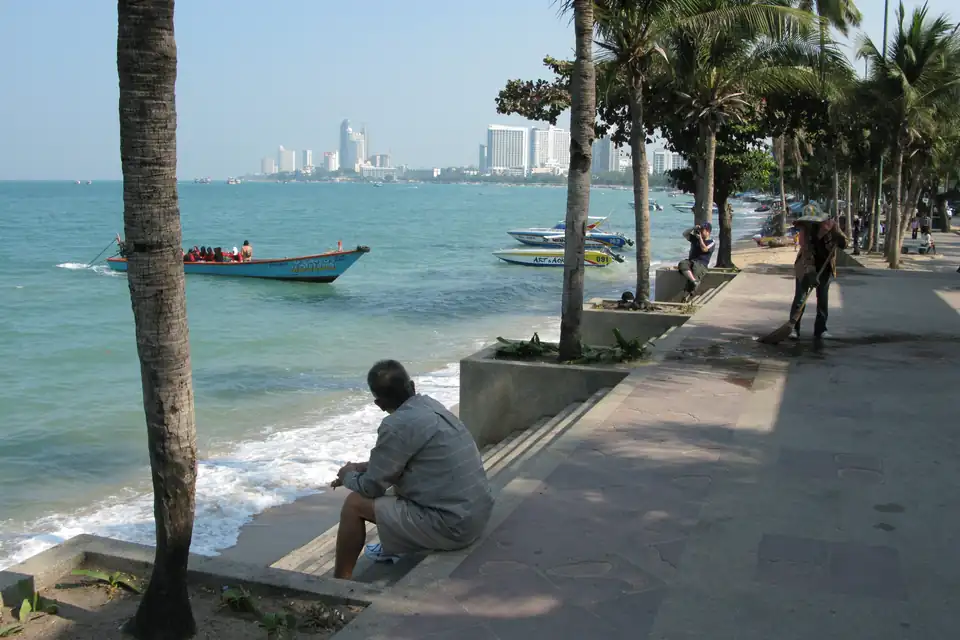
Pattaya Beach is the four-kilometre curve the city is named after, with Beach Road and the promenade behind it and the whole of central Pattaya behind that. Everything is walkable from it, which is its argument, and everything includes the parts you may not want walkable. The sand is narrow in places and the water is busy with boats.
Jomtien is six kilometres south over a headland and is effectively a different town: longer, wider, flatter, lower, and where most of the families and the long-stay residents are. It faces west, so the sunset is over the water and over Koh Larn on the horizon.
Wong Amat, at Naklua on the northern side, is the quietest of the three and the one with the hotels people return to. It is a short beach rather than a long one, and it is far enough from the centre to feel unrelated to it while being ten minutes from it.
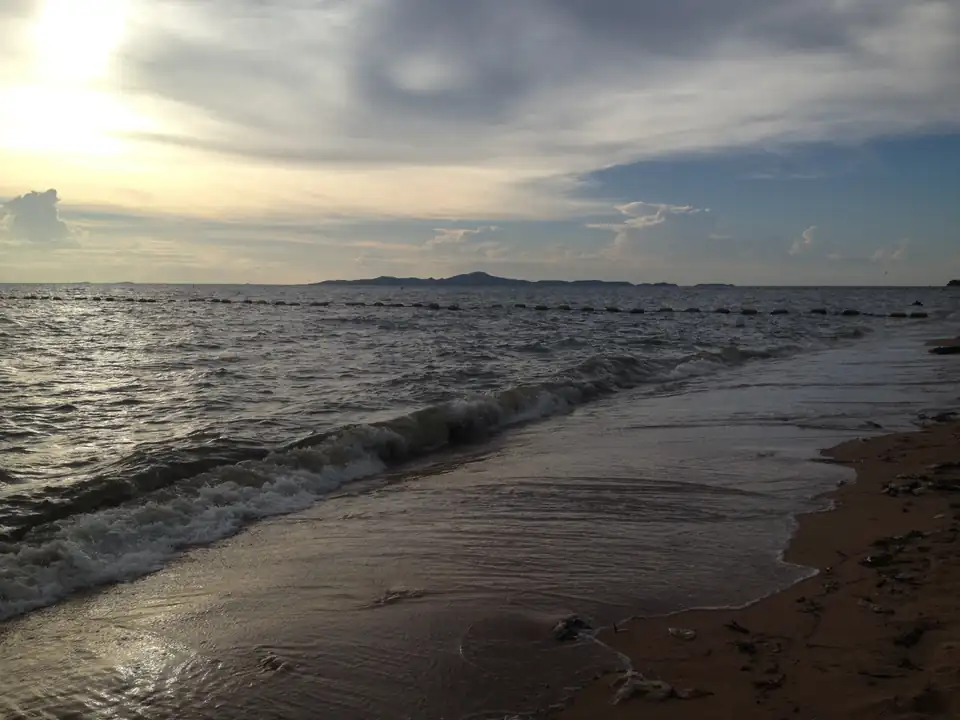
The sea does not decide this. Four years of marine reanalysis put all three between 0.20 metres and 0.59 metres across the year, and Pattaya Beach and Wong Amat sit in the same five-kilometre model cell and therefore carry the same numbers by construction. Jomtien has its own cell and differs from the others by a centimetre or two in some months, which is not a difference anybody can stand in.
So book the town, not the water. That is unusual advice on this site and it is what the measurements support here.
The driest beach on this site
This is the finding, and it is not what Pattaya is famous for.
- Rainfall, millimetres per month
- Koh Samet, for comparison
Driest is December at 16mm over 4 rain days, wettest is September at 249mm over 25 rain days. Against Koh Samet, Pattaya is wetter in 6 months of the twelve, and the largest gap is in November.
1,381mm a year, against 1,570 on Koh Samui, 1,592 on Koh Samet and 1,647 on Koh Tao. Every beach destination we hold thirty years of rainfall for is wetter than Pattaya. December takes 16mm across four rain days, which is the driest month anywhere on this site.
The comparison with Koh Samet, the other Bangkok weekend beach, splits with a neatness that is worth looking at. Pattaya is wetter in all six dry-season months and drier in all six wet ones. The dry-season margins are trivial, between 2mm and 15mm. The wet-season margins are not: 39mm in May, 67mm in June, 48mm in July, 47mm in August, 50mm in September. Pattaya loses a little in the good half of the year and wins a lot in the bad half.
Two other things the table shows. The peak is late: September at 249mm and October at 229mm, rather than the June to September run of the Andaman coast, so an October booking here is a different proposition from an October booking in Khao Lak. And the rain arrives in fewer, heavier events in the shoulder months than the monthly totals suggest, with November taking 68mm across ten days against May’s 158mm across twenty-two.
We publish no temperature for Pattaya. The reanalysis cell here is heavily maritime and reports a daily maximum below what the thermometer on the promenade says, and we would rather leave the figure out and explain why than print one we cannot defend.
The Sanctuary of Truth
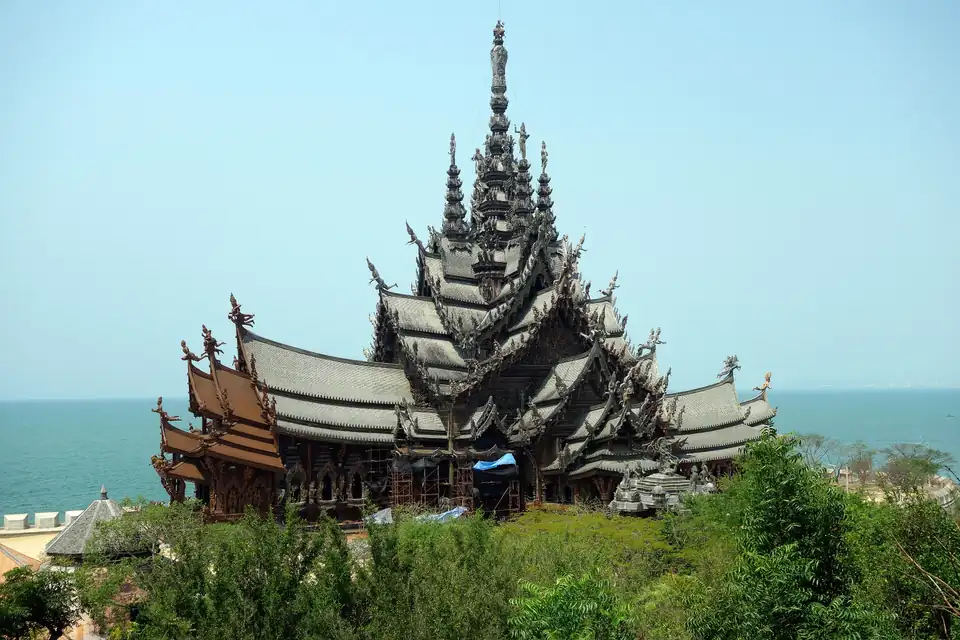
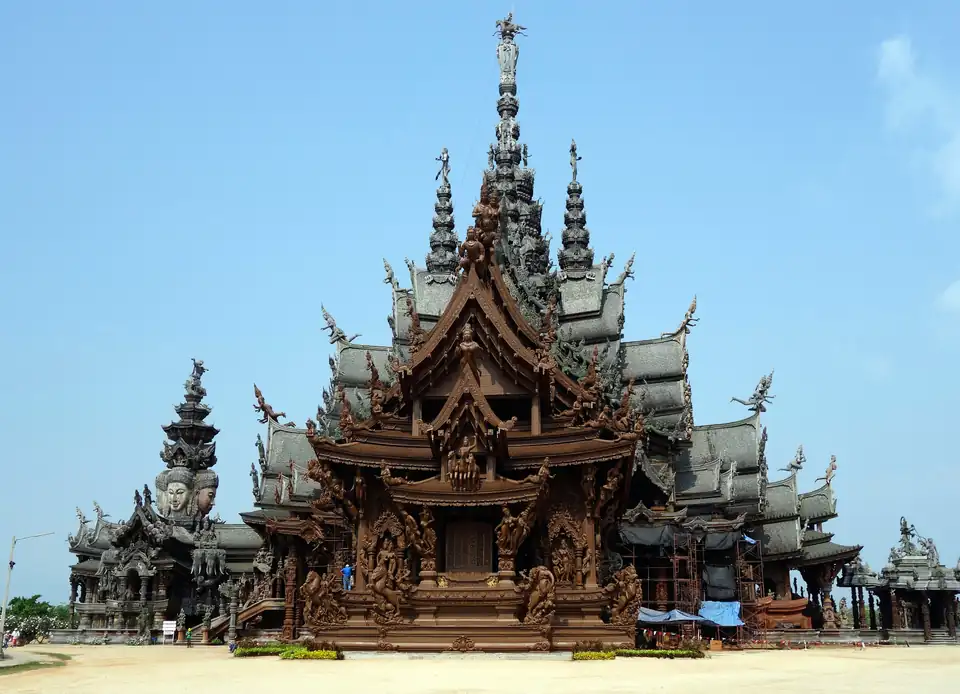
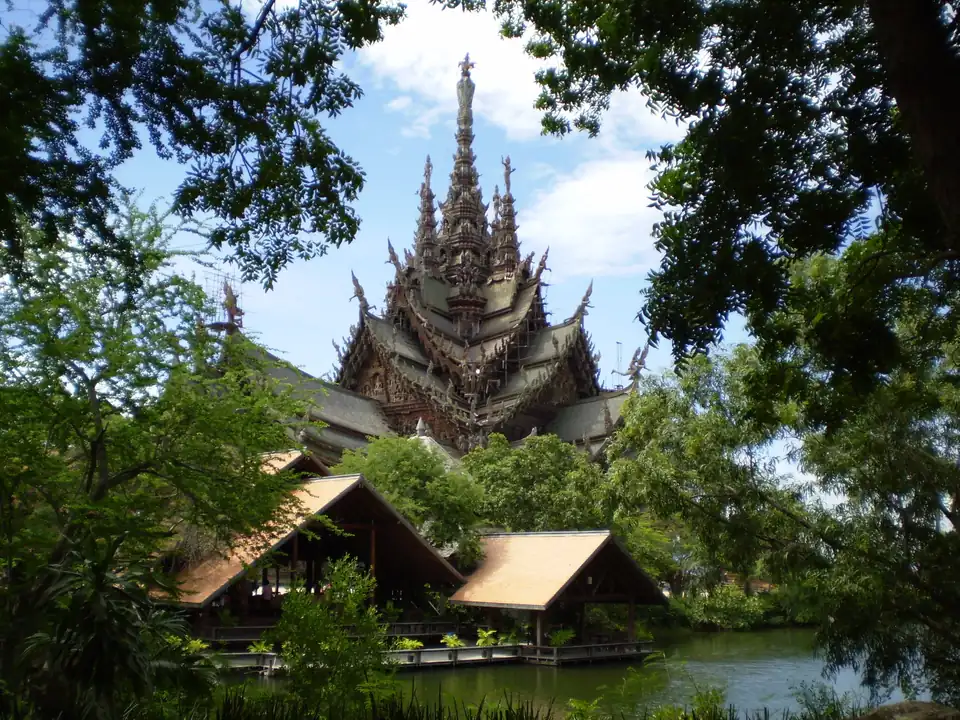
Begun in 1981 by a Thai businessman, Lek Viriyaphant, and still unfinished. It is a hundred metres or so of carved hardwood standing on the shore at Naklua, built of wood alone, and the claim made for it is that no nails were used anywhere in it. Every surface inside and out is carved with figures from Hindu and Buddhist cosmology.
The carving is the building’s permanent condition rather than a phase of it. Teak weathers on an exposed coast, so parts are replaced while other parts are still being made, and it has never at any point been finished. Visitors wear hard hats inside for that reason.
It is a private attraction and it charges admission. We publish no figure: entrance prices at Thai attractions move without notice and a stale number is worse than none. Allow an hour and a half, and go in the morning before the light gets flat on the sea side.
If you see one thing here that is not a beach, this is it, and it is genuinely unlike anything else in the country.
Koh Larn, and the water Pattaya’s own beaches do not have
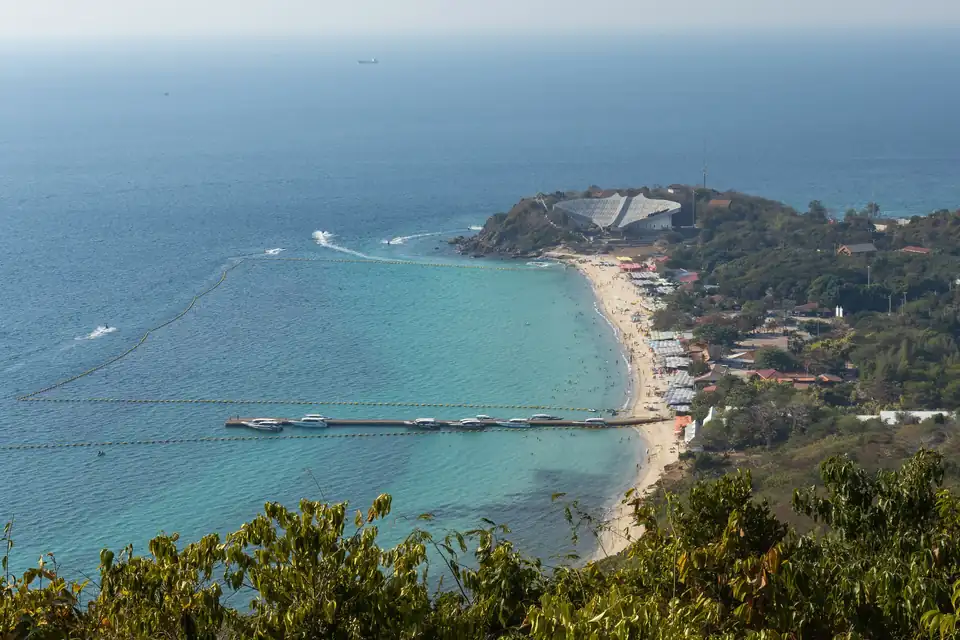
Pattaya Beach is a working bay with boats on it. The clear water is offshore, at Koh Larn, about seven kilometres out and reached from Bali Hai pier: 45 minutes to an hour on the scheduled ferry, 15 to 20 by speedboat.
It is a small island with several beaches, day-trip crowds on the nearest of them and much less on the far side, and it is the reason a Pattaya trip does not have to be a compromise on the swimming. It is also very busy at weekends, when Bangkok arrives, in exactly the way Koh Samet is.
The obvious pairing is a weekday. Both of these places are transformed by the difference between Tuesday and Saturday, and it is the single cheapest improvement available to anyone with a flexible date.
The rest of it
Nong Nooch, about twenty minutes south, is a large botanical garden with formal grounds, and it is better than that description makes it sound. It also runs elephant shows, and the questions worth asking before you buy a ticket to any of those are the ones we set out on the elephants page.
Khao Chi Chan, the Buddha cut into a cliff face south of the city, takes twenty minutes and is on the way to or from Nong Nooch rather than a destination on its own.
The malls are a real part of a Pattaya day rather than a wet-weather fallback, which is true of very few places on this site. In September and October, when the city takes 229mm to 249mm, that matters more than it sounds.
The full list, sorted by what each thing actually is rather than ranked, is on things to do in Pattaya. It includes the animal venues, named, and the reason the most photographed object in the city is thirty years old.
Getting there, and getting out
From Bangkok it is about two hours by road for roughly 145 kilometres, with buses about every half hour from Ekkamai and minivans from Ekkamai and Mo Chit. The route page has the timings, the frequencies and the one daily train. From Suvarnabhumi it is closer to ninety minutes and there are direct services from the airport, which is the single most useful fact here: Pattaya is a shorter transfer from Bangkok’s main airport than most of Bangkok is.
U-Tapao airport sits south of the city and takes a modest number of domestic and regional flights. It is worth checking and it is not usually the answer.
The searches that lead here include a large number of people leaving. Pattaya to Phuket and back is the busiest of them by some distance, and it is a flight rather than a drive: the two are on opposite coasts and the road is most of a day. Koh Samui is a flight as well. Koh Samet is the one that is genuinely close, about two hours east by road to Ban Phe and then a boat, which makes the two of them a plausible pair in one week rather than an either or.
Chiang Mai from here is a flight, usually through Bangkok, and it is worth an hour of checking whether flying out of Suvarnabhumi rather than U-Tapao is cheaper by more than the transfer costs.
How long to give it
Two to four nights for most people, and more if you have chosen Jomtien or Wong Amat deliberately and want a flat, cheap, easy beach week with the best coastal weather in the country. Pattaya rewards a decision about which part of it you are booking more than almost anywhere else here, and punishes booking it as one place.
Where it sits against every other beach in the country is on the beaches page, and the month-by-month picture for both coasts is on the best time to visit.
Top things to see in Pattaya
Getting to and from Pattaya
Times, how often each runs, and what it costs, for every route we have checked.
Popular Pattaya tours and day trips
 Free cancellation
Pattaya Full-Day 3 Tropical Island tour Snorkeling Cruise Buffet
 Free cancellation
Beginner Rider Tour Pattaya 28km ATV or Buggy Adventure
 Free cancellation
Pattaya Full Day Dirt Bike Tour

Tiffany's Show Pattaya: The World Class Best Show in Pattaya
 Free cancellation
Pattaya Discovery Tour with Floating Market, View Points & Lunch
 Free cancellation
Entry Ticket to the Sanctuary of Truth Pattaya
Pattaya FAQs
Where is Pattaya?+
On the eastern seaboard of the Gulf of Thailand, in Chonburi province, about 150 kilometres southeast of Bangkok and roughly 120 from Suvarnabhumi airport. It faces west across the upper Gulf, which is why the sun sets over the water here and not behind the hills. By road it is about two hours from central Bangkok and ninety minutes from the airport.
Is Pattaya worth visiting?+
It depends which Pattaya, and there are three of them within eight kilometres. Wong Amat and Jomtien are ordinary Thai beach holidays with the country's driest coastal weather. Central Pattaya is a large, loud, cheap city on a beach. The reputation attaches to one street at the southern end of the middle one.
Which is the best beach in Pattaya?+
Wong Amat at Naklua for quiet, Jomtien for families and space, Pattaya Beach itself for being able to walk to everything. The measured sea is effectively identical at all three, between 0.20 and 0.59 metres across the year, so this is a decision about the town behind the sand rather than about the water.
When is the best time to visit Pattaya?+
November to April, and December in particular at 16mm of rain across four days, which is the driest month of any beach destination on this site. September and October are the wet ones at 249mm and 229mm. Note that the peak is late here, unlike the Andaman coast.
Is Pattaya rainy?+
Less than anywhere else we measure on either coast: 1,381mm across the year, against 1,570 on Koh Samui and 1,592 on Koh Samet. The pattern is the interesting part. Pattaya is slightly wetter than Koh Samet in all six dry-season months and considerably drier in all six wet ones.
How do you get from Bangkok to Pattaya?+
About two hours by road for roughly 145 kilometres by road, and the buses run about every half hour from Ekkamai. From Suvarnabhumi airport it is closer to ninety minutes and there are direct services. U-Tapao airport is south of the city and takes a small number of domestic and regional flights.
What is there to do in Pattaya besides the beach?+
The Sanctuary of Truth at Naklua, a carved wooden building on the sea that has been under construction since 1981, is the one genuinely unusual thing here. Beyond it: Koh Larn island offshore, Nong Nooch garden south of the city, and the malls, which in Pattaya are a real part of the day.
Is Pattaya good for families?+
Jomtien and Wong Amat are, and central Pattaya is a harder argument. The three are on the same eight kilometres of coast and are genuinely different places to wake up in, so the decision is which one you book rather than whether you come.
Other destinations
 Bangkok
  Chiang Mai
  Phuket
  Krabi
Krabi  Koh Samui
  Khao Lak
  Chiang Rai
  Pai
Pai  Ayutthaya
  Sukhothai
  Koh Phangan
  Koh Tao
  Trat
Trat  Koh Mak
  Koh Kood
  Koh Chang
  Koh Samet
  The Similan Islands
  Koh Phi Phi
  Koh Lanta
  Koh Lipe
  Thailand Islands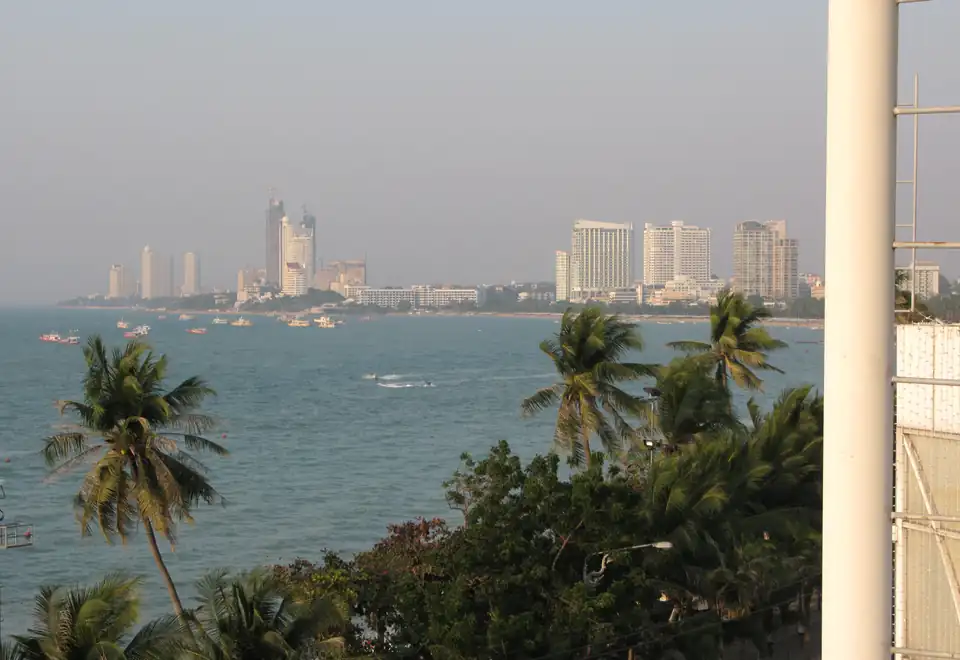
Areas covered: Pattaya Beach, Jomtien, Wong Amat & Naklua, Koh Larn.