
Ayutthaya · Central Thailand
Ayutthaya Travel Guide
Ayutthaya was the capital of Siam for four hundred years and one of the largest cities on earth before a Burmese army destroyed it in 1767. What is left is a UNESCO-listed island of brick prangs and headless Buddhas ninety minutes north of Bangkok, and it is the best day trip the capital has.
- Driest months
- November to April 6 months under 150mm, 15 rain days or fewer
- Best for
- The ruined capital, in a day
- Airport
- Bangkok (BKK or DMK), 90 minutes
- Getting around
- Bicycle and tuk-tuk
Ayutthaya was founded in 1350 and was, for the next four hundred years, the capital of Siam and one of the great cities of Asia: a river island of temples and palaces trading with the Dutch, the Portuguese, the French, the Persians, the Chinese and the Japanese, each with a quarter of their own on the far bank. Thirty-three kings ruled from it. In April 1767, after a siege of more than a year, a Burmese army took the city and burned it, and what was left of the court moved south to found what became Bangkok.
What survives is a UNESCO World Heritage site of brick prangs, foundation walls and beheaded Buddhas, spread over an island that the Chao Phraya, the Lopburi and the Pa Sak wrap around. It is not a reconstruction. It is a ruin, and it is far more affecting for it.
The four that matter
There are dozens of ruins on and around the island and most visitors see four. These are the four, and the order below is the order that works.
Wat Mahathat
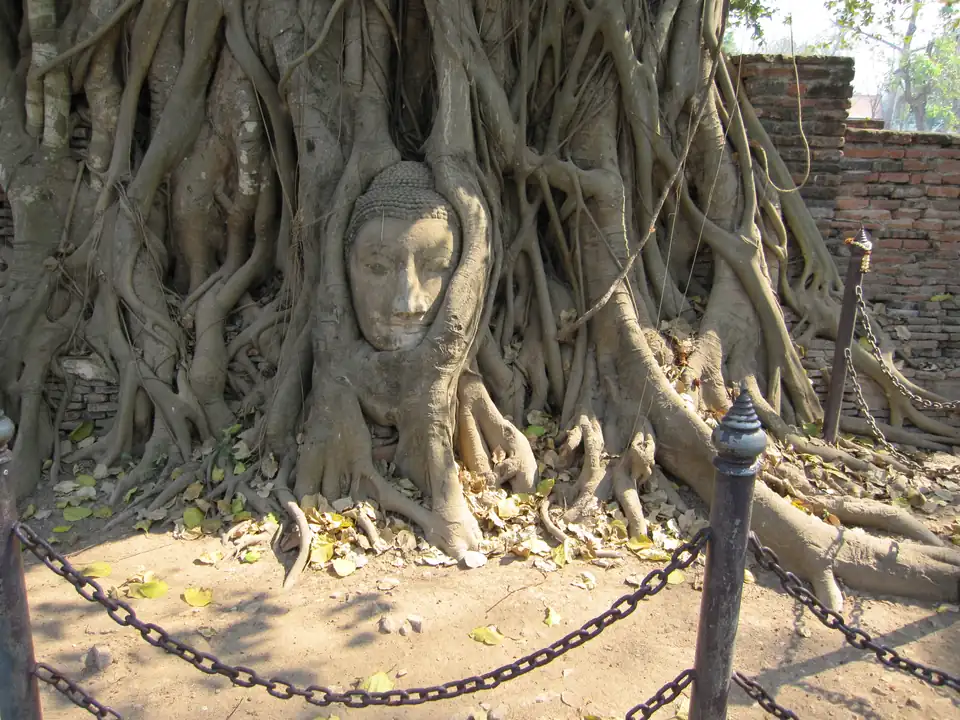
The image everyone knows: a sandstone Buddha head grown into the roots of a fig tree, at what was the most important temple in the kingdom and the seat of its patriarch. Nobody is certain how the head came to be there. The likeliest account is simply that it fell in the sack and the tree grew around it over two centuries.
It is roped off and it is small, and there is a queue. The rest of the compound, a field of headless seated Buddhas along the foundation walls and the stump of a prang that was among the tallest in the city, is worth more of your time than the photograph is, and almost nobody gives it any.
Wat Phra Si Sanphet
Three restored bell-shaped chedis in a row, and the shape most people picture when they picture Ayutthaya. This was the royal temple inside the palace grounds, and unlike the others it never housed monks: it was the king’s chapel, and the three chedis hold the ashes of three fifteenth-century kings. Bangkok’s Wat Phra Kaew, built after the fall, is the deliberate copy of it.
The palace beside it is foundations and a lawn. It is the emptiest important place on the island and it repays ten quiet minutes.
Wat Chaiwatthanaram
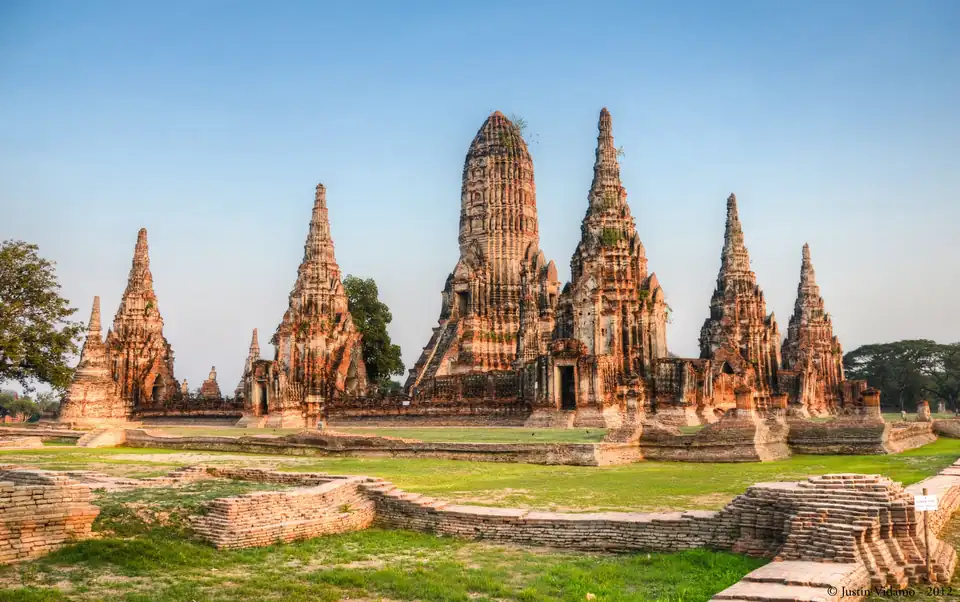
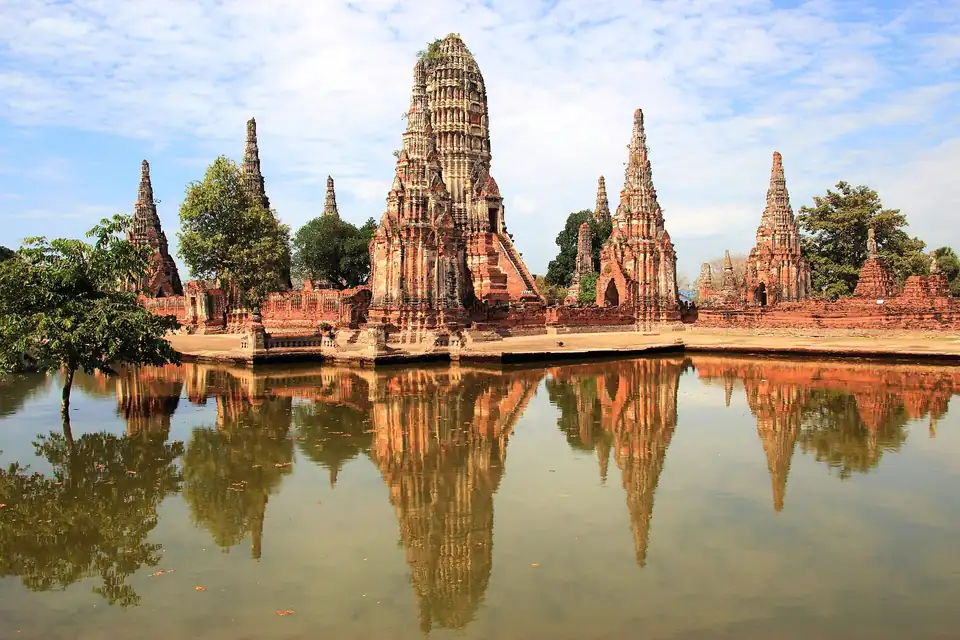
The most complete thing in Ayutthaya and the most photographed: a Khmer-style complex on the river bank west of the island, built in 1630 by King Prasat Thong, with a central prang ringed by eight chedis and a gallery of seated Buddhas around the outside.
It is across the water from the island, which means it is the one that needs planning, and it is worth planning for. Go last. It faces west, the brick warms through the late afternoon, and the twenty minutes before sunset are the best light anywhere here.
Wat Yai Chai Mongkhon
Southeast of the island, and the one that is not a ruin: a working temple with monks in it, a very large reclining Buddha under the open sky, rows of seated Buddhas in saffron cloth, and a chedi you can climb for the only elevated view of the plain you will get. It is the counterweight to the other three: after a morning of foundations, somewhere that is still in use.
The hour, and the heat
The single largest thing you control here is what time you arrive, and it matters more at Ayutthaya than at any other day trip from Bangkok for one reason: there is essentially no shade. The trees that were here burned or were cleared, the site is brick and lawn, and the brick radiates by mid-morning.
- Daily low to daily high, 21C to 36C across the year
- Rainfall, millimetres per month
- Bangkok, for comparison
Driest is December at 8mm over 2 rain days, wettest is September at 296mm over 26 rain days. Hottest is April, averaging 35.5C by day, and coolest is January, which drops to 21.4C at night. That night figure is the one nobody packs for. Against Bangkok, Ayutthaya is wetter in 8 months of the twelve, and the largest gap is in August.
April is the month to be careful of, at a daily maximum of 35.5C on an open site, and it is also the month of Songkran, which is why a great many people find themselves here in exactly the wrong week. If you have a choice, come between November and February, when the maximum sits between 31 and 33 and the plain is dry.
Whatever the month, be on the island by eight. The organised coaches from Bangkok arrive around ten, the heat arrives shortly after, and the two hours before both are the quiet, cool, photographable ones. This is not a marginal gain. Arriving at eight instead of eleven is the difference between the two versions of this place.
Why the flood month is not the wettest month
Ayutthaya is an island about four metres above sea level at the confluence of three rivers, and the water that passes it mostly fell somewhere else. That is worth understanding before you plan around “the rainy season”, because the local rain and the river are not the same series.
| Where the rain falls | J | F | M | A | M | J | J | A | S | O | N | D | Peak |
|---|---|---|---|---|---|---|---|---|---|---|---|---|---|
| Chiang Mai on the Ping Upper catchment, on a Chao Phraya headwater | January: 11mm | February: 9mm | March: 13mm | April: 37mm | May: 135mm | June: 145mm | July: 221mm | August: 276mm | September: 269mm | October: 132mm | November: 32mm | December: 12mm | A 276mm |
| Sukhothai on the Yom Middle catchment, on a second headwater | January: 15mm | February: 19mm | March: 39mm | April: 77mm | May: 221mm | June: 189mm | July: 216mm | August: 237mm | September: 288mm | October: 174mm | November: 37mm | December: 13mm | S 288mm |
| Ayutthaya the island Where the rivers meet, four metres above the sea | January: 13mm | February: 22mm | March: 46mm | April: 85mm | May: 176mm | June: 158mm | July: 172mm | August: 194mm | September: 296mm | October: 183mm | November: 42mm | December: 8mm | S 296mm |
In October 2011 the historical park went under. Wat Chaiwatthanaram stood in water for weeks, the industrial estates around the town were submerged, and the damage to the ruins took years to make good. All of it happened in the month when Ayutthaya’s own rainfall had already dropped by more than a third from its September peak. The water was northern rain, arriving late.
Nothing on this page forecasts a flood, and we do not model the river. Serious flooding here is rare rather than annual. But if you are booking for October and the news out of northern Thailand has been wet, that is the one month where it is worth checking before you commit, and the reason is upstream rather than overhead.
Getting around the island
The island is about four kilometres across and the temples are spread over all of it, so walking is not realistic in the heat and nobody sensible tries.
A bicycle is the classic answer, hired near the station or at any guesthouse for very little. The island is flat, the distances suit it, and it is the way to see the smaller ruins between the famous ones, which is where a good deal of Ayutthaya actually is.
A tuk-tuk by the half or full day is the comfortable answer and costs little more. It is the right call in April, with children, or if Wat Chaiwatthanaram at sunset is the plan and you would rather not cycle back in the dark.
Coming by train, you arrive on the east bank and cross to the island by a short ferry from beside the station, which is a nicer arrival than it sounds and costs almost nothing.
Tickets
Ayutthaya is not a gated park in the way Sukhothai is. Much of the site is open ground you can ride through, and the major compounds, Mahathat, Phra Si Sanphet, Chaiwatthanaram and several others, each charge admission at their own gate. There is also a combined ticket covering a group of them, sold at the same gates, which is worth buying if you intend to see more than two.
We publish no figures. Admission prices at Thai historical sites change without notice and a stale number is worse than none; expect a modest amount at each gate and rather less per temple on the combined ticket.
Day trip, or a night
Almost everyone comes for the day and it works: ninety minutes each way, five or six hours on the island, back in Bangkok for dinner. The route page has the trains, the minivans and what each actually costs you in time.
Staying a night is the better version and very few people do it. Three things change. The main temples are floodlit after dark and the island is silent by then. The coaches leave around four and take the crowd with them, which hands you the last light at Chaiwatthanaram. And you get the following morning from opening, which is the hour this page has been arguing for.
The hotel search here is thin and largely branded, a handful of riverside places and a scatter of guesthouses near the station, which is a reasonable signal of how few people stay. That is the argument for staying, not against it.
Eating
Two things are worth going out of your way for. Giant river prawn, kung mae nam, grilled and split, is the province’s signature and is sold along the river and at the night market by the bridge; it is not cheap and it is the local extravagance rather than a tourist one. Roti sai mai is the other: strands of candy floss wrapped in a thin, soft pancake, made by the town’s Muslim community and sold from roadside stalls all along the approach roads. It is Ayutthaya’s own sweet and it exists almost nowhere else.
The night market on the river runs most evenings and is a local market rather than a tourist one, which is another small argument for the overnight.
Two things we would skip
The elephant rides. There are elephants carrying tourists around the ruins here, and it is one of the more visible ride operations in Thailand. The questions we would want answered before booking anything with elephants in it, what happens when nobody is visiting, whether the animals are ridden and where they came from, are set out on our elephants page, along with the two venues out of twenty-four that passed them. None of them is in Ayutthaya.
The floating market. Ayothaya Floating Market, east of the island, is a purpose-built attraction rather than a working market: boardwalks, souvenir stalls and scheduled shows. If a floating market is on the list, it is a fine hour with children and it is not a historical one, and it is worth knowing which of those you are buying.
The purple temple at Sena, if you have a car
Thirty minutes west of the historical park, in Sena district, is a temple that has nothing to do with everything above and is the reason a number of people now drive out here: Wat Klang Khlong Watthanaram, known to almost everyone as the purple temple.
It is a modern working temple, not a ruin, which is worth saying plainly on a page otherwise about the fourteenth to eighteenth centuries. The ordination hall is finished in lavender and deep violet where a Thai temple is normally gold and red, set with mirror mosaic, and the floor inside is worked to look like the surface of a pond, with fish and lotus apparently below it.
There is no public transport to it. That is the single most useful thing to know, and it is why this is a note on the Ayutthaya page rather than a day out in its own right: if you have already hired a tuk-tuk or a driver for the island, extending the afternoon to Sena is straightforward, and if you came by train and bicycle it is not.
Two honest caveats. The published opening hours disagree with each other, so if the drive is the point of your afternoon, ring ahead or ask your driver to. And it is a temple people actually worship in rather than an attraction: shoulders and knees covered, shoes off in the hall, and the floor everyone photographs is a floor people kneel on.
Ayutthaya or Sukhothai
The two ruined capitals are constantly compared and they are not really alternatives. Sukhothai came first, in the thirteenth century, and is where the Thai script and the walking Buddha were made. Ayutthaya inherited those forms, elaborated them for four centuries and was destroyed at the height of it.
The difference on the ground is larger than the difference in the history. Ayutthaya is a working provincial town with ruins standing in it, complete with traffic and power lines at the edge of the frame. Sukhothai is a park with lawns and lotus ponds and a town twelve kilometres away, and you can hear birds. Ayutthaya is grander and Sukhothai is calmer.
The practical answer is distance. Ayutthaya is ninety minutes from Bangkok and Sukhothai is six hours. On a first trip of a week or two, see Ayutthaya. Sukhothai earns its day when you are travelling between Bangkok and Chiang Mai anyway, which is the only itinerary it fits neatly into.
When to go
November to February is the season and it is not close: 42mm, 8mm, 13mm and 22mm, on an open site with a daily maximum in the low thirties. December and January are the best of it.
March and April are hot and getting hotter, peaking at 35.5C in April with the rain still light. It is doable if you are on the island at eight and off it by eleven, and it is punishing if you are not. Songkran falls on 13 April.
May to October is the wet half, running from 176mm in May to 296mm in September across twenty-six rain days. The ruins are green, the light after a storm is the best of the year, the crowds thin out and the middle of any given day is unpredictable. October is the flood month, for the reasons above.
Why this guide has no sub-pages
Because the searches do not exist, and we counted them. Ayutthaya draws close to six thousand searches a month in Britain across every phrasing of the name, and the bare word “ayutthaya” is 2,200 of that on its own. Under it: about 900 for getting here from Bangkok and doing it as a day trip, 800 for the temples, 550 for the historical park by name, 270 for hotels (nearly all of that people typing the name of one specific hotel) and 70 for food. Those clusters overlap, because a phrase like “ayutthaya historical park temples” belongs to two of them.
The one cluster large enough to stand alone is getting here from Bangkok, and it already has a page of its own with the trains and the minivans on it.
Splitting the rest would produce four thin pages where one good one belongs, and it would take the temples, the thing the head term is actually asking about, off the page that has to answer it. If that changes, this is the page that splits.
Getting to and from Ayutthaya
Times, how often each runs, and what it costs, for every route we have checked.
Ayutthaya FAQs
Is Ayutthaya worth visiting?+
Yes, and it is the single best day out from Bangkok. It is a genuine ruin rather than a reconstruction: brick prangs, foundation walls and beheaded Buddhas across a river island that was one of the largest cities on earth until a Burmese army destroyed it in 1767. Give it a full day rather than a half.
How do you get from Bangkok to Ayutthaya?+
By train from Krung Thep Aphiwat, which takes about ninety minutes to two hours, runs through the day and costs very little. Minivans from Mo Chit are quicker on paper and at the mercy of Bangkok's traffic in practice. Our Bangkok to Ayutthaya page has the timings for both.
How long do you need in Ayutthaya?+
One full day covers the four temples that matter with time to sit down. A half day covers two of them badly. A night turns it into a different trip: the temples are lit after dark, the island empties when the coaches leave, and you get the first hour of the next morning to yourself.
What time should you arrive in Ayutthaya?+
By eight if you can. Ayutthaya is an open site with almost no shade, brick that holds heat, and an April daily maximum of 35.5C. Most day-trippers arrive around ten. The two hours before that are the coolest and the emptiest of the day, and they are the whole difference.
Do you need a ticket for Ayutthaya historical park?+
The park is not gated as a whole, and you can cycle through most of it freely, but the major temple compounds each charge admission at their own gate, and there is a combined ticket covering several of them that is worth buying if you intend to see more than two. We publish no figures: Thai admission prices change without notice.
How do you get around Ayutthaya?+
A bicycle, hired near the station or at any guesthouse, is the classic answer and the cheapest. A tuk-tuk hired by the half or full day is the comfortable one and costs little more. The island is about four kilometres across with the temples spread over all of it, so walking it is not realistic in the heat.
Ayutthaya or Sukhothai?+
Ayutthaya if you have a week, Sukhothai if you have three. Ayutthaya is grander, more complete and ninety minutes from Bangkok; Sukhothai is quieter, greener and six hours away. Ayutthaya is a working town with ruins in it. Sukhothai is a park.
Does Ayutthaya flood?+
It has, seriously. The island sits about four metres above sea level where three rivers meet, and in October 2011 the historical park went under: Wat Chaiwatthanaram stood in water for weeks. That is rare rather than annual, and the thing worth knowing is that the risk peaks in October, after the local rain has already begun to fall away.
 Bangkok
  Chiang Mai
  Phuket
  Krabi
Krabi  Koh Samui
  Khao Lak
  Chiang Rai
  Pai
Pai  Sukhothai
  Koh Phangan
  Koh Tao
  Trat
Trat  Koh Mak
  Koh Kood
  Koh Chang
  Koh Samet
  The Similan Islands
  Pattaya
  Koh Phi Phi
  Koh Lanta
  Koh Lipe
  Thailand Islands