
Sukhothai · Northern Thailand
Sukhothai Travel Guide
Sukhothai was the first Thai capital and the place the Thai alphabet and the classic walking Buddha come from. Its historical park is quieter, greener and better preserved than Ayutthaya's, and it is far enough from Bangkok that almost nobody comes for the day, which is most of its appeal.
- Driest months
- November to April 6 months under 150mm, 15 rain days or fewer
- Best for
- The first capital, and no crowds
- Airport
- Sukhothai (THS)
- Getting around
- Bicycle
Sukhothai was the capital of the first independent Thai kingdom from the middle of the thirteenth century, and it is where a great deal of what is now taken to be Thai began: the script, the classic walking Buddha with its impossible smoothness, the temple architecture that Ayutthaya inherited and elaborated.
It fell into the orbit of Ayutthaya within two centuries and was abandoned. Restoration in the twentieth century turned it into a park, and it became a UNESCO World Heritage site alongside Ayutthaya in 1991.
How it differs from Ayutthaya
Ayutthaya is a working town with ruins in it. Sukhothai is a park with a town seven hundred metres away, and the difference is enormous: no traffic, no wires, no shophouses at the edge of the frame. Lawns, moats, lotus ponds and brick, and you can hear birds.
It is also much quieter, and for one reason: Ayutthaya is ninety minutes from Bangkok and Sukhothai is six hours. Almost nobody comes for the day, so the people here have chosen to be.
What it was
Sukhothai means the dawn of happiness, and the kingdom it named lasted about two hundred years from the middle of the thirteenth century. Its third king, Ramkhamhaeng, is credited with the Thai script, and the stone inscription that carries that claim is one of the founding documents of the country, argued over by historians ever since.
What is not argued over is the art. The Sukhothai walking Buddha, with its impossible smoothness and its weightless stride, is the one wholly original Thai contribution to Buddhist sculpture, and it was made here. Ayutthaya inherited the forms and elaborated them; the versions in this park are the ones the rest came from.
The park
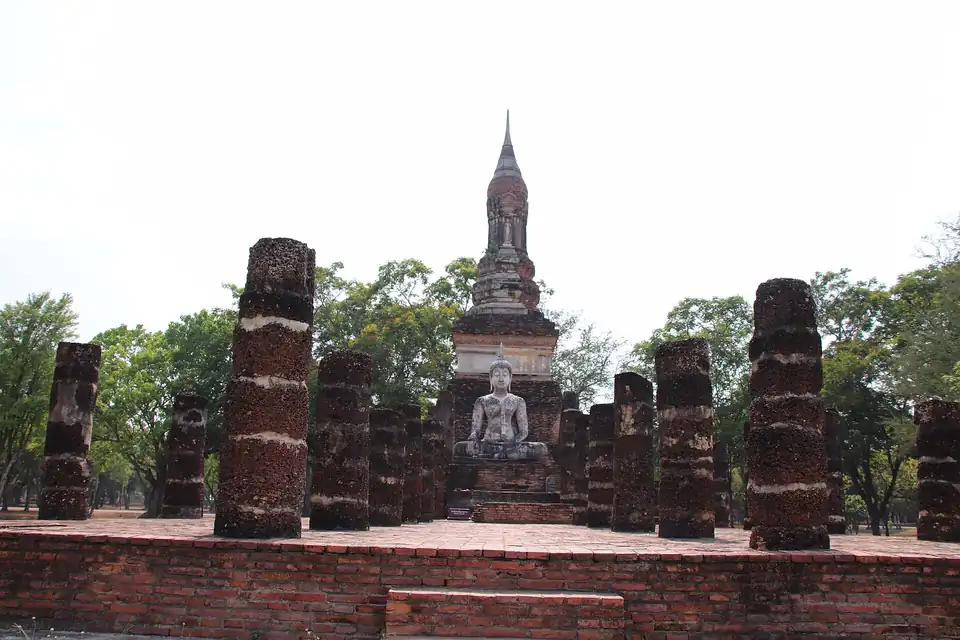
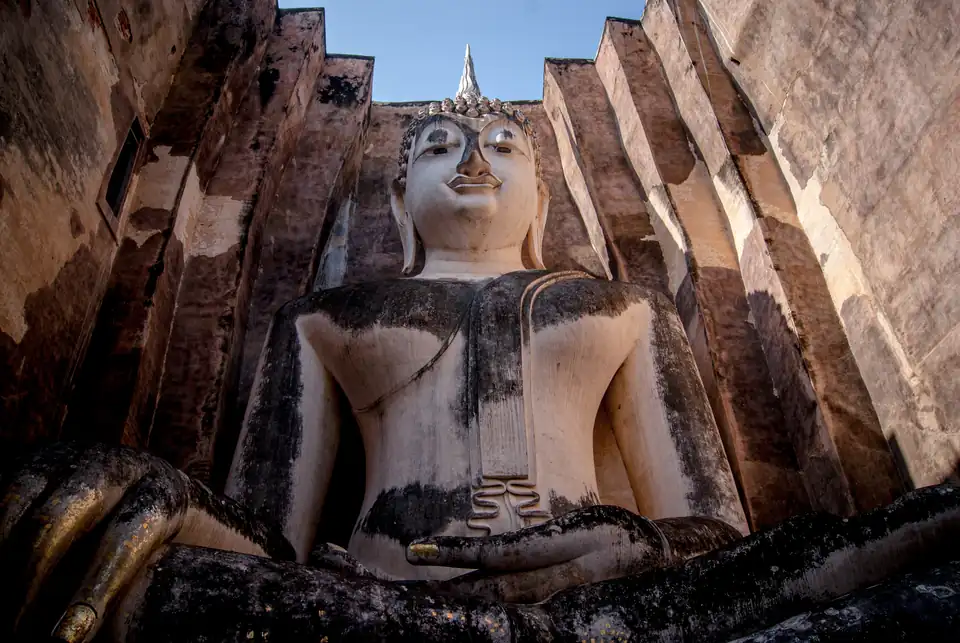
Three zones, and the central one holds most of what you came for. Wat Mahathat is the largest complex, a forest of columns around a lotus-bud chedi with a seated Buddha at its centre. Wat Si Chum, in the north zone, is one very tall seated Buddha in a roofless brick box, visible through a slot in the wall, and it is the most startling thing in Sukhothai.
Wat Sa Si sits on an island in a pond and is the one to be at when the light drops. Wat Si Sawai has three Khmer prangs and predates the Thai kingdom entirely.
Hire a bicycle at the gate. The central zone is flat, shaded in places, and made for one.
Si Satchanalai
An hour north, a second walled city of the same kingdom, larger in area and with a fraction of the visitors. If Sukhothai worked for you, this is the follow-up, and on a weekday you may share it with nobody.
New town and old town
Sukhothai has two halves twelve kilometres apart. The new town has the bus station, the cheap rooms and the night market; the old town is the park and a handful of guesthouses at its edge. Staying in the old town costs a little more and saves the commute, and it means being there at opening and at closing when the light is worth it.
Getting there
Sukhothai has a small airport with flights from Bangkok, run by Bangkok Airways, and it is the quick way. Otherwise it is six or seven hours by bus from Bangkok, five from Chiang Mai. It sits naturally between the two, which is the best reason to build it into an itinerary rather than to make a trip of it.
How long, and what it pairs with
Two nights. One full day in the park and its zones, one morning for Si Satchanalai or a slow second pass at the central zone in better light. A single night means seeing the middle of it in the middle of the day, which is the worst version.
It sits almost exactly between Bangkok and Chiang Mai, which is the strongest argument for it: as a stop on the way north it costs you a day and changes the shape of a fortnight. As a destination in its own right it is a long way to go for ruins, however good they are, and Ayutthaya ninety minutes from Bangkok is the version most people should do instead.
When to go
November to February. Loy Krathong is held in the park itself and Sukhothai claims to be where the festival began; it is the one night of the year the place is crowded, and it books out months ahead. The 2026 full moon falls on 24 November; how the festival works, and how it differs from what is sold in the north, is on our lantern festival page.
The rest of the year runs on the northern calendar rather than the coastal one: dry and cool from November to February, hot and hazy from late February into April when the burning season reaches this far south, and wet from May to October, when the park is green and nearly empty.
Why this guide has no sub-pages
Because the searches do not exist. We looked: strip out the Thai restaurants in Harrogate and Leeds, the hotel of the same name in Bangkok and the one in Shanghai, and Sukhothai as a destination draws something in the region of two thousand searches a month in Britain, most of it on the name alone.
Building separate pages for its temples, its weather and its hotels would produce four thin pages where one good one belongs, which is a thing this site has decided not to do. If that changes, this page will be the one that splits.
 Bangkok
  Chiang Mai
  Phuket
  Krabi
Krabi  Koh Samui
  Khao Lak
  Chiang Rai
  Pai
Pai 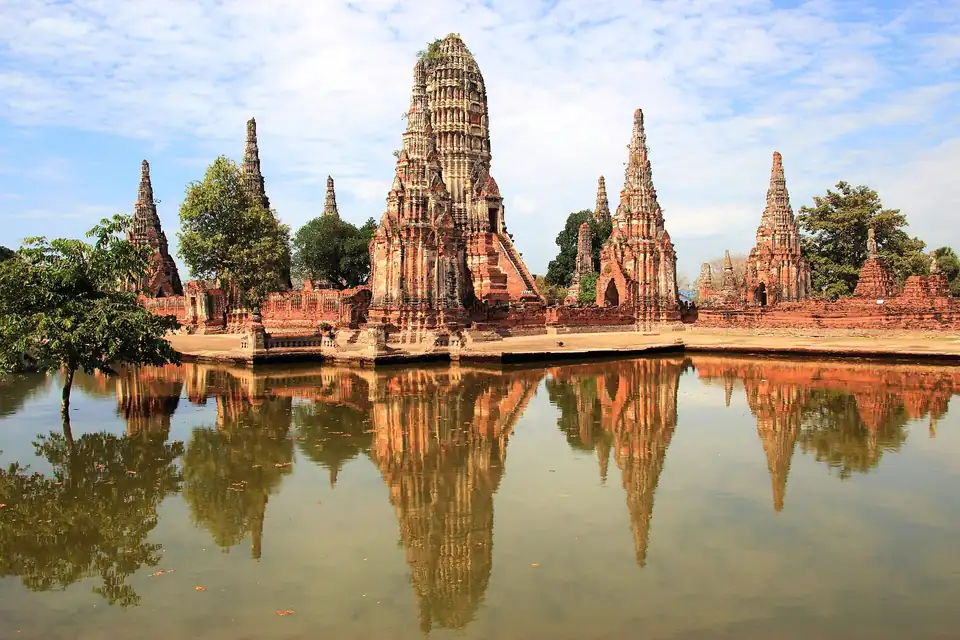 Ayutthaya
  Koh Phangan
  Koh Tao
  Trat
Trat  Koh Mak
  Koh Kood
  Koh Chang
  Koh Samet
  The Similan Islands
  Pattaya
  Koh Phi Phi
  Koh Lanta
  Koh Lipe
  Thailand Islands