
About Thailand
The Thai Flag
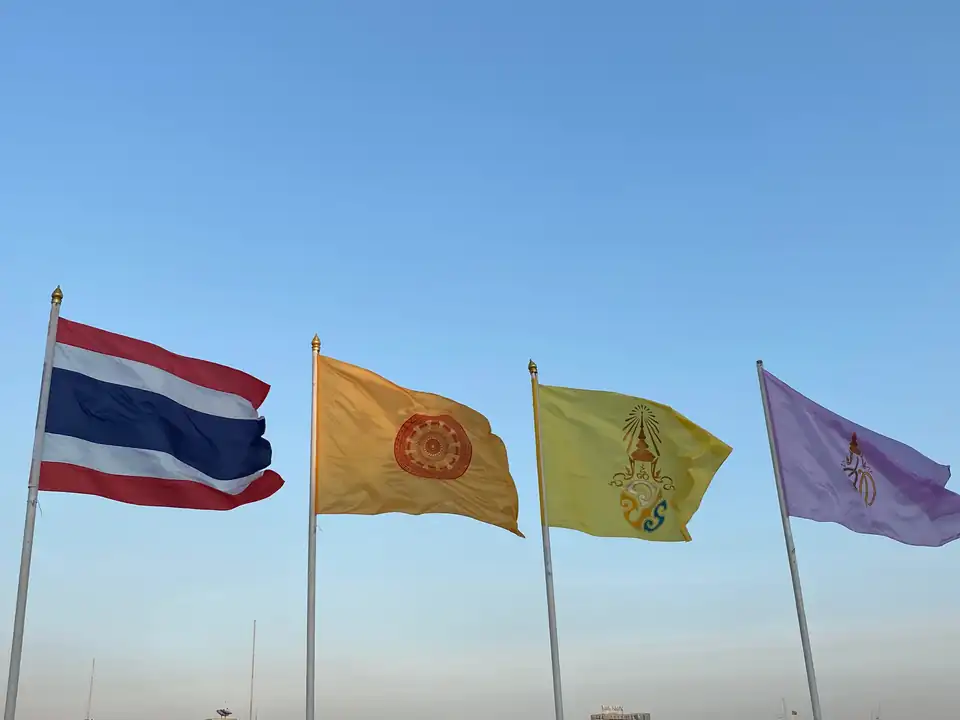
Five horizontal stripes, red, white, blue, white, red, with the blue one twice the width of the others. It is called Thong Trairong, the tricolour flag, and it is a diagram of the three things the Thai state has been built on since 1917: nation, religion and monarchy, in that order from the outside in.
- Red The nation and its people
- White Religion, meaning Buddhism
- Blue The monarchy
- The blue band is double width, which is not decoration. It is the middle of the flag and the widest stripe on it, and it stands for the monarchy.
The middle stripe used to be red
The design arrived in stages. Earlier flags of Siam put a white elephant, a royal animal, on a plain red field. By the middle of the 1910s that had given way to horizontal stripes, but the centre band was red like the outer ones, making the flag red and white only.
On 28 September 1917, King Vajiravudh, Rama VI, issued the decree that made the middle stripe blue. Two reasons are usually given and they are not in conflict: blue was the colour associated with the king himself, and a red, white and blue flag put Siam visually alongside Britain, France, Russia and the United States, the Allies it had just declared for in the First World War.
That date is now National Flag Day.
Nation, religion, monarchy
The three colours are not an aesthetic choice. Nation, religion and monarchy are the stated pillars of the modern Thai state, invoked together in official language, and the flag sets them out in order: the people on the outside, the faith inside that, and the crown at the centre and twice the width.
Whether that ordering is a description or an aspiration is a question for somewhere other than a travel guide. What is worth knowing is that the flag is read this way in Thailand and is treated accordingly. Religion in Thailand covers the middle stripe; the people covers the outer ones.
The part that affects you
At 08:00 and 18:00, everybody stops
Twice a day, in parks, railway and bus stations, schools, government offices and plenty of public squares, the national anthem is broadcast and the flag is raised or lowered with it. People stop walking, stop talking and stand still until it finishes, which takes about a minute.
For civilians this is a convention rather than a law; the old fine for ignoring it was abolished. It is nevertheless observed almost universally, and a visitor carrying on through a station concourse while a hundred people stand motionless is a conspicuous sight. The practical instruction is the whole of it: if everyone around you stops, stop.
The practice dates to the government of Plaek Phibunsongkhram, who ordered the anthem played at those two times each day. It remains compulsory for military and police personnel.
Frequently asked questions
What do the colours of the Thai flag mean?+
Red is the nation and its people, white is religion, and blue is the monarchy. Those three, in that order, are the traditional pillars of the Thai state, and the flag is a diagram of them.
Why is the middle stripe of the Thai flag blue?+
It was red until 1917. King Vajiravudh, Rama VI, changed it to blue that September, and two reasons are usually given: blue was the colour associated with the king, and a red, white and blue flag aligned Siam visually with the Allies it had just joined in the First World War.
What was the Thai flag before 1917?+
Earlier flags of Siam carried a white elephant on a red field, the elephant being a royal symbol. The stripes came first without the blue, and the blue arrived in 1917.
What is the Thai flag called?+
Thong Trairong, which means the tricolour flag. It was adopted on 28 September 1917, and that date is now Thailand's National Flag Day.
Why does everyone stop moving at 8am in Thailand?+
The national anthem is broadcast at 08:00 and 18:00 in public places across the country, and the flag is raised or lowered as it plays. People stop where they are and stand still for about a minute. It is a social convention rather than a legal requirement for civilians, and it is observed almost universally, so the polite thing is to stop too.
More about the country: the language, religion, the people.