About Thailand
The Thai Language
Thai is spoken by nearly everyone in the country and is unrelated to any language you are likely to know. It has five tones, an alphabet of its own, and no spaces between words. It also has no plurals, no verb tenses and no articles, which makes it far easier to speak badly than most European languages and much harder to speak well.
The part that surprises people
The same syllable is five different words
Thai is tonal. Pitch is not expression, it is spelling. The syllable mai means new, not, wood, burn or a spoken question mark, and which one depends entirely on whether your voice goes up, down, stays flat, dips or rises.
In practice this matters less than it sounds. Context carries most of it, and nobody expects a visitor to land the tones. It is worth knowing so that when a phrase does not work, you know why, and so that you say it again rather than louder.
Twelve phrases, and when to use them
The roman spellings below are approximate, because Thai has sounds English does not and marks tones English cannot. Say them anyway. The script is there so a phrase can be shown to somebody when saying it fails.
- ครับ / ค่ะ khrap / kha the polite particle Added to the end of almost anything. Men say khrap, women say kha, and it is the single change that most alters how you are answered.
- สวัสดี sawatdee hello, and goodbye With the particle: sawatdee khrap, sawatdee kha. Works at any hour and in any direction.
- ขอบคุณ khop khun thank you Again with the particle. Said far more often than its English equivalent.
- ไม่เป็นไร mai pen rai never mind, it's fine, no problem The most Thai phrase there is. It answers an apology, a thank you, a spilled drink and a cancelled ferry.
- เท่าไหร่ tao rai how much? At a market or a tuk-tuk. Have a number in mind before you ask.
- แพงไป phaeng pai too expensive The other half of a market conversation, said with a smile. Bargaining is normal in markets and not in shops.
- อร่อย aroi delicious Say it to whoever cooked. It lands every time.
- ไม่เผ็ด mai phet not spicy Order it before the dish is made, not after. Phet nit noi is a little spicy.
- กินเจ gin jay I eat vegetarian Jay is the Buddhist vegetarian tradition and excludes fish sauce, which the English word vegetarian does not.
- ห้องน้ำ hong nam toilet Hong nam yu thi nai for where is the toilet.
- ขอโทษ kho thot sorry, excuse me For getting past someone, and for anything you have just knocked over.
- เช็คบิล chek bin the bill, please In a restaurant. Borrowed straight from English, which is why it sounds familiar.
The script, and why you will not read it
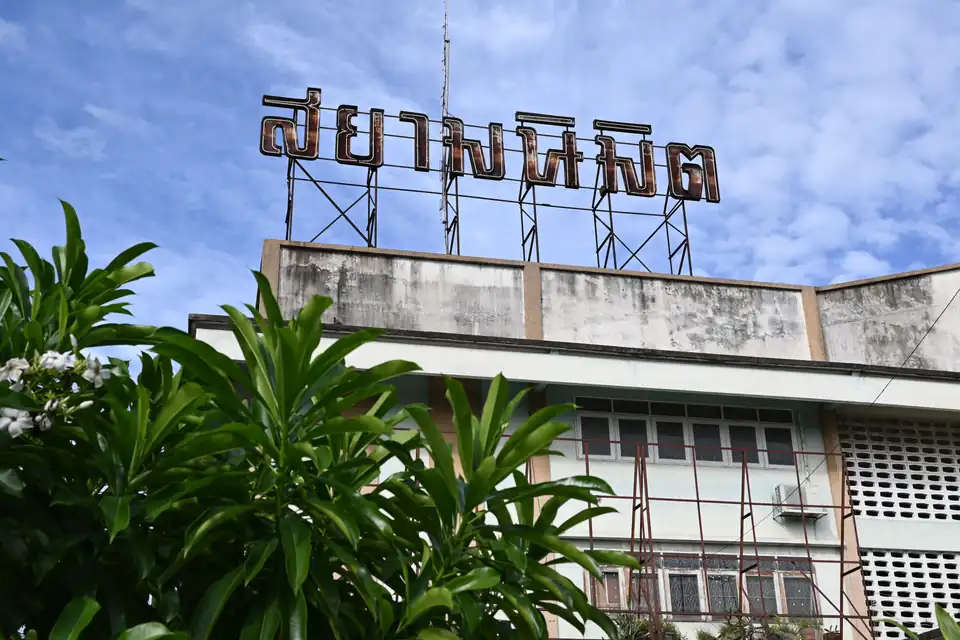
Thai is written in an abugida of 44 consonants and around 28 vowel forms, with four tone marks and no spaces between words. Spaces exist, but they mark the end of a clause or a sentence rather than the end of a word, which is why a line of Thai looks like one very long word to anyone who has not learned it.
You will not learn to read it in a fortnight and you do not need to. Road signs, transport and menus in visited areas carry roman transliteration, and Thai numerals have largely given way to the ones you already use. Where you still see Thai numerals is worth knowing about: occasionally on a price board where the Thai figure and the visitor figure are not the same.
It is not one language everywhere
Central Thai is the official language, the one taught in schools and the one on television. Alongside it, Isan is spoken across the northeast by roughly a third of the country and is close enough to Lao to be mutually intelligible with it. Northern Thai, or Kam Mueang, is the language of the old Lanna kingdom around Chiang Mai. Southern Thai is fast and clipped enough that central Thais sometimes struggle with it. In the four provinces on the Malaysian border, the first language of most people is Patani Malay.
A large Chinese-Thai population, particularly in Bangkok, adds Teochew and Hokkien, mostly among older speakers.
Where English gets you
Everywhere a visitor is expected: hotels, airports, ferry counters, tour desks, and the restaurants and bars of Bangkok, Phuket, Chiang Mai, Krabi and the islands. Menus in those places are bilingual and staff are used to being asked things.
It thins fast outside them. In small-town Isan, on a local bus, at a district hospital or in a market that is not on any itinerary, you should expect none at all, and an offline translation app earns its download. This is not a complaint about Thailand; it is a country of sixty-six million people where about forty million of them will never meet a tourist.
How to behave in a temple is the other half of getting this right, and it is not a language problem.
Frequently asked questions
What language do they speak in Thailand?+
Thai, the official language, spoken by almost everyone. It is tonal, written in its own alphabet, and unrelated to Chinese despite the shared use of tones. Isan in the northeast, Northern Thai around Chiang Mai and Patani Malay in the far south are all spoken daily alongside it.
Is English widely spoken in Thailand?+
In hotels, tour offices, airports and the tourist parts of Bangkok, Phuket, Chiang Mai and the islands, yes. Away from those it thins out quickly, and in rural Isan you should expect none. A translation app that works offline is worth more than a phrasebook.
How hard is Thai to learn?+
The grammar is easier than most European languages: no plurals, no verb tenses, no articles, no gendered nouns. The tones and the script are the hard part. Five tones means the same syllable is five different words, and the alphabet has 44 consonants with no spaces between words.
Do I need to learn Thai to visit Thailand?+
No. You need about six phrases, and the most useful of them is khrap or kha on the end of your sentences.
How do you say hello in Thai?+
Sawatdee, with khrap if you are male and kha if you are female. It covers hello and goodbye at any time of day.
More about the country: religion, the people, the flag.