
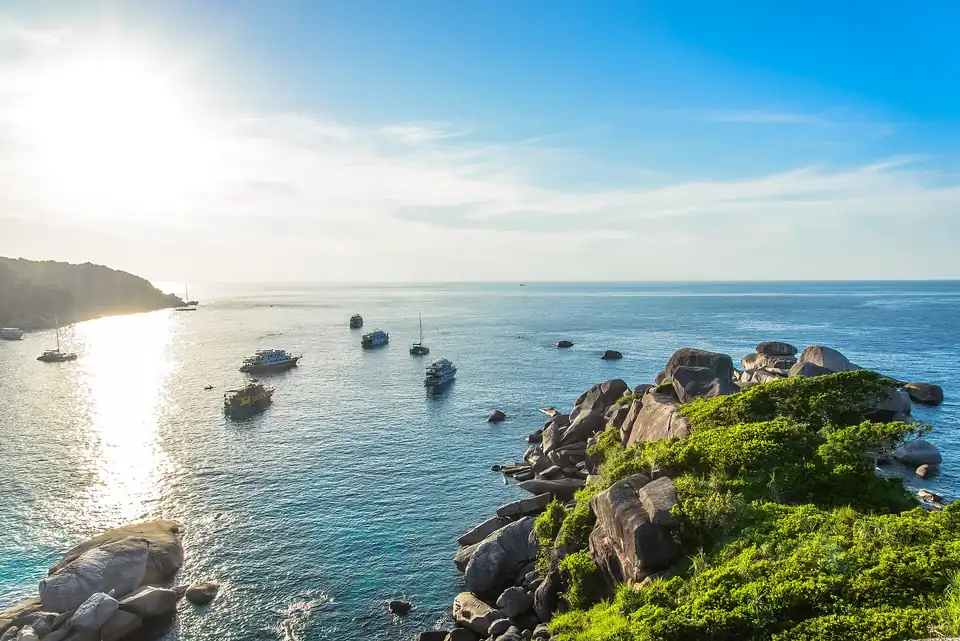
The Similan Islands
Getting to the Similan Islands
Every boat leaves from the same pier south of Khao Lak, whichever town you book in. That one fact settles most of the planning, and it is why a Phuket booking is the same boat with three extra hours of minibus attached.
There is one thing to understand about reaching the Similan Islands and it settles almost every question that follows: every boat leaves from Thap Lamu pier, a few kilometres south of Khao Lak, whether you book in Khao Lak, in Phuket, in Krabi or on a website in another country.
There is no airport out there, no ferry, no public boat and no second pier. The islands are a national park sixty kilometres offshore with no permanent population, and access is entirely by booked trip.
So the question is never how to get to the Similans. It is where you are sleeping the night before, and how much of the day you are willing to spend in a minibus getting to a boat that would have left without you either way.
From Khao Lak
The right answer, and the reason Khao Lak exists as a destination.
Thap Lamu is roughly fifteen to twenty minutes south of Nang Thong, the main Khao Lak beach. Pickups run at around half past seven or eight in the morning, you are on the water inside the hour, and you are back on the mainland in the late afternoon with an evening left. The dive operators are here, the day-boat operators are here, and so are the liveaboards.
If the Similans are a real reason for your trip, sleep in Khao Lak. Two nights is enough to make a day trip civilised; more if you are diving. Where to stay in Khao Lak covers which stretch of that coast to pick, and the short version is one of the two walkable ones.
From Phuket
Sold heavily, and it is the same boat.
Thap Lamu is about ninety kilometres by road from Phuket, which is an hour and a quarter to an hour and a half from the airport at the island’s north end, and appreciably longer from Patong or Kata at the other. A Phuket day trip therefore starts with a hotel pickup somewhere between five and half past six in the morning, adds that drive, then adds the ninety-minute crossing, and reverses all of it at the end of the day.
Realistically it is a fourteen-hour day of which around six are spent travelling and three or four are at the islands. It works, thousands of people do it every season, and nobody who has done it recommends it over the Khao Lak version.
The useful middle option: fly into Phuket, which is the airport for this coast anyway, and drive straight up. The route page has the transfer figures, and the same trip booked from the airport rather than from a beach hotel avoids an hour of Phuket’s traffic.
From Krabi
It is sold, and we would not do it.
Krabi to Thap Lamu is around three hours each way by road, and it is on the wrong side of Phang Nga bay for this. That makes a day trip roughly six hours in a vehicle plus three on a boat, for a few hours at the islands, with a pickup in the dark. Krabi has excellent islands of its own that are forty minutes away rather than three hours.
If the Similans are the point, treat them as a separate leg of the trip and give Khao Lak two nights.
What the day actually costs you
The pattern is the same in all three cases: the boat is identical, the pier is identical, and what changes is how much of your day you spend on a road to reach it.
The crossing, and why the beach lies to you
Ninety minutes in a speedboat across open ocean is not a ferry ride, and the most common mistake made at the pier is looking at the water in front of you and drawing a conclusion from it.
| Mean daily-maximum wave height | J | F | M | A | M | J | J | A | S | O | N | D |
|---|---|---|---|---|---|---|---|---|---|---|---|---|
| Koh Similan The middle of the chain, 60km offshore, no land in front of it. | 0.67 January: 0.67 metres | 0.66 February: 0.66 metres | 0.60 March: 0.60 metres | 0.64 April: 0.64 metres | 1.17 May: 1.17 metres | 1.42 June: 1.42 metres | 1.61 July: 1.61 metres | 1.40 August: 1.40 metres | 1.53 September: 1.53 metres | 1.01 October: 1.01 metres | 0.76 November: 0.76 metres | 0.76 December: 0.76 metres |
| Richelieu Rock Further north and more sheltered. Liveaboard range only. | 0.55 January: 0.55 metres | 0.50 February: 0.50 metres | 0.43 March: 0.43 metres | 0.44 April: 0.44 metres | 0.82 May: 0.82 metres | 1.05 June: 1.05 metres | 1.20 July: 1.20 metres | 1.05 August: 1.05 metres | 1.14 September: 1.14 metres | 0.69 October: 0.69 metres | 0.58 November: 0.58 metres | 0.66 December: 0.66 metres |
| Nang Thong, Khao Lak The mainland beach the boats leave from. | 0.30 January: 0.30 metres | 0.30 February: 0.30 metres | 0.29 March: 0.29 metres | 0.35 April: 0.35 metres | 0.65 May: 0.65 metres | 0.80 June: 0.80 metres | 0.93 July: 0.93 metres | 0.82 August: 0.82 metres | 0.90 September: 0.90 metres | 0.57 October: 0.57 metres | 0.38 November: 0.38 metres | 0.34 December: 0.34 metres |
The shaded months are when Mu Ko Similan has historically been closed, roughly mid-May to mid-October.
Nang Thong, the Khao Lak beach in that table, is the sea you can see. Koh Similan is the sea you are crossing to, and it runs between 1.7 and 2.2 times the wave height in every month of the year, because it sits in open water with nothing in front of it. Flat sand at eight in the morning is not evidence about half past nine.
Two practical consequences. Take something for seasickness before boarding, not when you first notice, because it does not work applied late and a proportion of every boat needs it. And if you have a choice of month, February and March are the flattest of the open season, at about 0.6 metres, while late October is around 1.0.
Liveaboards leave from the same place
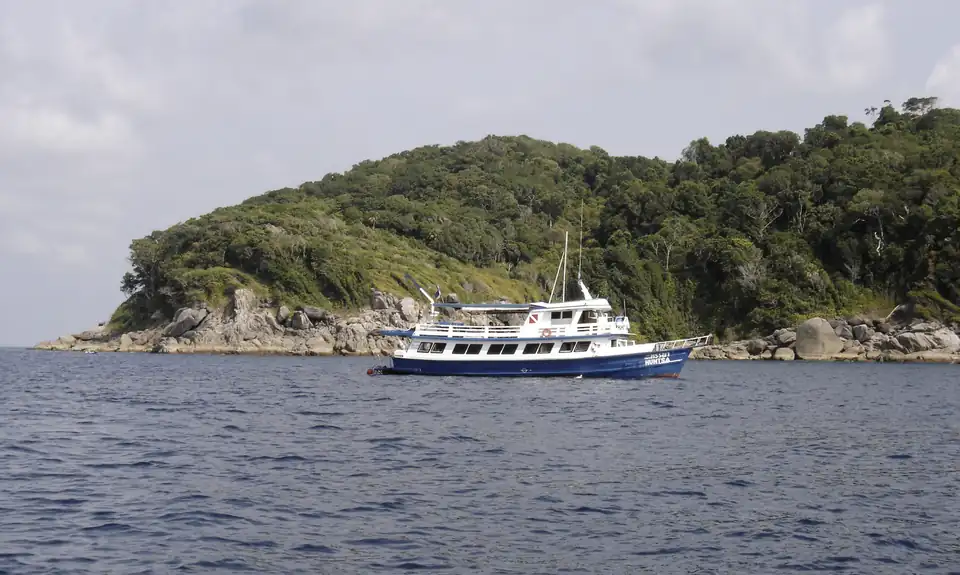
Multi-day dive boats also depart Thap Lamu, and they change the arithmetic entirely: the crossing is made overnight while you sleep, so it costs no daylight, and you wake up at the islands. That is a large part of why a liveaboard is the serious diver’s answer and not merely the expensive one.
The one thing to check before you book anything
The park is closed for roughly half the year, historically from around mid-May to mid-October, and the dates are set each season by the park authority rather than by any operator. They move by weeks and they have occasionally been announced late.
Book flights around the Similans only after checking the current season directly. A fortnight in early May and a fortnight in late May have been different holidays more than once. What the islands are and what the closure tracks are on the Similan Islands guide.
Getting to the Similan Islands FAQs
How do you get to the Similan Islands?+
By boat from Thap Lamu pier, a few kilometres south of Khao Lak in Phang Nga province, and by no other route. Speedboats take about ninety minutes to the main chain. There is no airport, no ferry service and no public boat: everything is a booked trip, day or liveaboard.
Similan Islands from Phuket or from Khao Lak?+
Khao Lak, clearly, if you have a choice about where to sleep. Boats leave from Thap Lamu whichever you book, so booking in Phuket buys the identical boat with roughly ninety minutes of minibus at each end of the day, on top of a crossing that is already ninety minutes each way.
How far are the Similan Islands from Phuket?+
About 60km offshore from the Phang Nga coast, and around 90km by road from Phuket to Thap Lamu pier before you get on any boat. A Phuket day trip is realistically a fourteen-hour day with a pickup somewhere between five and half past six in the morning.
Can you visit the Similan Islands from Krabi?+
It is sold and we would not do it. Krabi to Thap Lamu is around three hours by road each way, on top of the three hours of boat, which makes a day trip roughly six hours in a vehicle and three on a boat for a few hours at the islands. If the Similans matter to you, move to Khao Lak for two nights.
How long is the boat to the Similan Islands?+
About ninety minutes each way by speedboat from Thap Lamu to the main chain, sometimes closer to two hours depending on the sea and which island you start at. A liveaboard usually makes the crossing overnight, so you wake up there.
Is the boat to the Similan Islands rough?+
Rougher than the beach you left, in every month of the year. The Similans sit in open ocean with nothing to windward and run between 1.7 and 2.2 times the wave height of the Khao Lak beaches. Take something for seasickness before you leave rather than after you notice.