
The Similan Islands
Diving the Similan Islands
Granite swim-throughs on the west of the chain, coral gardens on the east, manta rays at Koh Bon and whale sharks at Richelieu Rock. What each site is, whether a day boat or a liveaboard is the right call, and the water temperature measured rather than promised.
The Similans are the reason Thailand has a diving reputation at all, and the reason is compression: granite architecture, coral gardens and open-water pelagic sites all inside a chain you can cross in an afternoon, in water that never drops below about 29 degrees at the surface.
What follows is what each part of that is, and the single decision that shapes the trip more than any other, which is not which sites but which boat.
The two sides of the chain
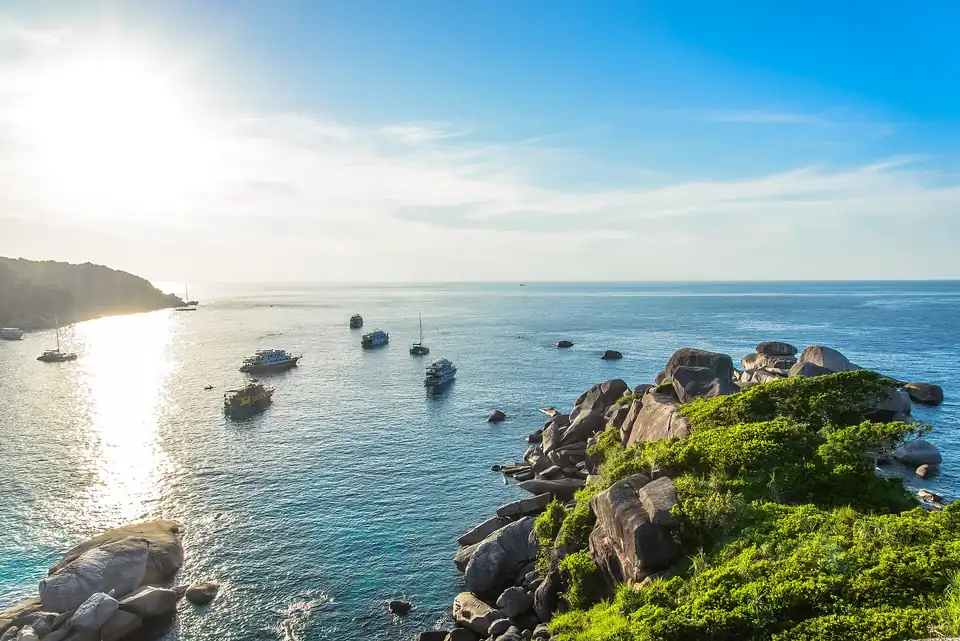
The Similans are nine granite islands running roughly north to south, and the diving is different on each side of them.
The west side is the architecture. House-sized granite boulders stacked into swim-throughs, arches and canyons, dropping to about thirty metres. Elephant Head Rock between islands seven and eight is the best-known of them: three pinnacles breaking the surface with a maze of passages underneath. Christmas Point at the northern end is the other. These are the dives people remember, and they are the ones that want reasonable conditions, because the same open water that makes them dramatic makes them exposed.
The east side is the reef. Gentler slopes, hard and soft coral, and the shallow sites the day boats use for the second and third dives of the day. Less spectacular, considerably more life per square metre, and where a nervous diver or a snorkeller has the better time.
North of the park
Three sites north of the main chain are what a liveaboard is for, and no day boat from Thap Lamu reaches them.
Koh Bon is a limestone ridge with a wall and a pinnacle, and it is the manta ray site: they come to be cleaned there and they are the reason people dive it repeatedly rather than once.
Koh Tachai is a pinnacle in open water with the strongest current of the group, and enough of it to bring through schooling fish, barracuda and the occasional larger animal. Worth knowing: the island’s beach was closed to visitors in 2016 after the reef there was worn out, and it has stayed that way. The diving continues and the sand does not, which is a fair summary of how this park has been managed for a decade.
Richelieu Rock is not in the Similan park at all. It is a horseshoe of submerged pinnacle in Mu Ko Surin, further north again, and it is the most celebrated dive site in Thailand.
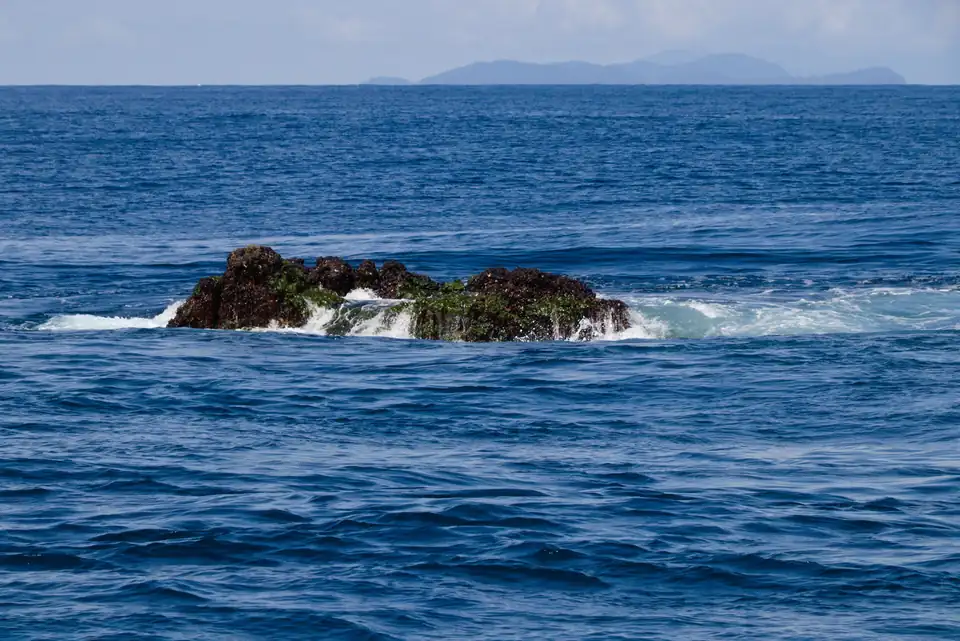
The photograph is the point. From the boat it is a lump of rock the size of a car, in open ocean, with nothing else in any direction. Everything that makes it famous, the purple soft coral over the whole structure, the seahorses, the frogfish, the schooling trevally, is underneath.
It is also Thailand’s best-known whale shark site, and here we are going to be less useful than the operators. We publish no whale shark season and no odds. Sightings are irregular, the claims made about which months are best do not agree with each other, and we have no measured series to put behind any of them. Book Richelieu because the site is exceptional and treat a whale shark as the thing that would make it a story.
Day boat or liveaboard
This is the decision. Everything else is detail.
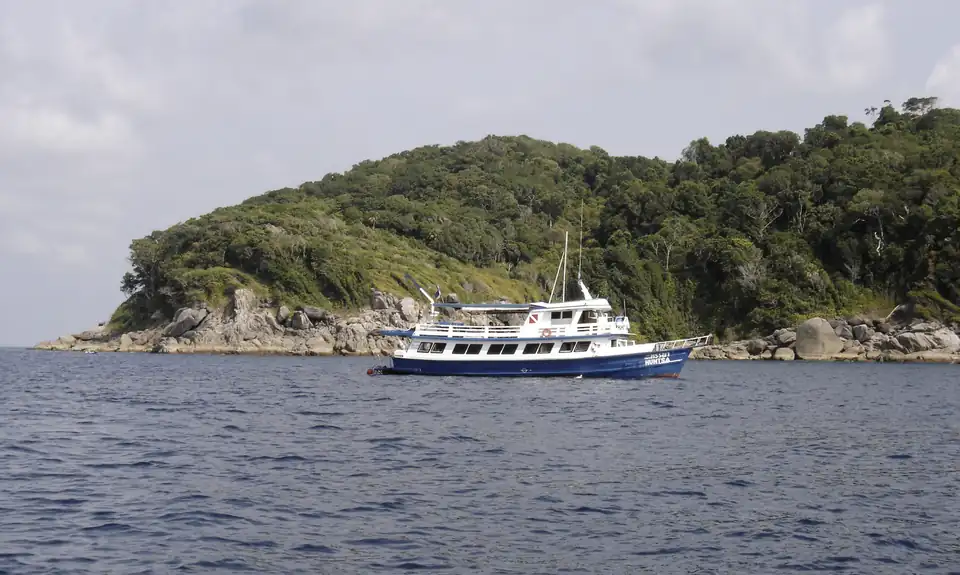
Take the day boat if you dive occasionally, if you are travelling with people who do not dive, or if the Similans are one item on a two-week Thailand trip. You will get two or three good dives and a long day on the water, and it is the sensible version.
Take the liveaboard if diving is why you are here. The arithmetic is blunt: a day trip buys you roughly three dives for two boat crossings, and a four-night liveaboard buys you fifteen to twenty for one. It also puts you at the good sites early and late, when the day fleet is either not there yet or already gone, and it is the only thing that reaches the north.
The cost of the liveaboard is not only money. It is four days in which you are on a boat and nowhere else, which suits some people entirely and some people not at all.
The season, and what the sea does to it
The park is shut for roughly half the year and the closure tracks the swell rather than the calendar.
| Mean daily-maximum wave height | J | F | M | A | M | J | J | A | S | O | N | D |
|---|---|---|---|---|---|---|---|---|---|---|---|---|
| Koh Similan The middle of the chain, 60km offshore, no land in front of it. | 0.67 January: 0.67 metres | 0.66 February: 0.66 metres | 0.60 March: 0.60 metres | 0.64 April: 0.64 metres | 1.17 May: 1.17 metres | 1.42 June: 1.42 metres | 1.61 July: 1.61 metres | 1.40 August: 1.40 metres | 1.53 September: 1.53 metres | 1.01 October: 1.01 metres | 0.76 November: 0.76 metres | 0.76 December: 0.76 metres |
| Richelieu Rock Further north and more sheltered. Liveaboard range only. | 0.55 January: 0.55 metres | 0.50 February: 0.50 metres | 0.43 March: 0.43 metres | 0.44 April: 0.44 metres | 0.82 May: 0.82 metres | 1.05 June: 1.05 metres | 1.20 July: 1.20 metres | 1.05 August: 1.05 metres | 1.14 September: 1.14 metres | 0.69 October: 0.69 metres | 0.58 November: 0.58 metres | 0.66 December: 0.66 metres |
| Nang Thong, Khao Lak The mainland beach the boats leave from. | 0.30 January: 0.30 metres | 0.30 February: 0.30 metres | 0.29 March: 0.29 metres | 0.35 April: 0.35 metres | 0.65 May: 0.65 metres | 0.80 June: 0.80 metres | 0.93 July: 0.93 metres | 0.82 August: 0.82 metres | 0.90 September: 0.90 metres | 0.57 October: 0.57 metres | 0.38 November: 0.38 metres | 0.34 December: 0.34 metres |
The shaded months are when Mu Ko Similan has historically been closed, roughly mid-May to mid-October.
For diving specifically, two things follow. Visibility follows flatness, so February and March, the two flattest months, are also the best visibility of the year and are priced accordingly. And the shoulder is real: October reopens at about 1.01 metres against February’s 0.66, so an early-season liveaboard is cheaper, rougher, and more likely to have a site dropped from the itinerary because the skipper does not like the look of it.
Water temperature, and the thermocline
Four years of marine reanalysis put the surface at Koh Similan between 28.9C in September and 30.9C in May, which is to say warm in every month the park is open and warm in the months it is not. A 3mm suit or a shorty is plenty and a good number of people dive in a rash vest.
The honest caveat is that a surface figure is a surface figure. The Similans are known among divers for pronounced thermoclines, and the drop at depth can be several degrees and can arrive over a metre of descent rather than gradually. That is not something we measure and we are not going to put a number on it; it is the reason people who dive here regularly bring more neoprene than the surface temperature suggests.
Getting to the boat
Every dive boat, day or liveaboard, leaves from Thap Lamu pier south of Khao Lak. Booking in Phuket does not change the pier, it adds a minibus at each end of the day. Getting to the Similan Islands sets out what each starting point actually costs you.
Khao Lak is where the dive industry lives and it is the sensible base: the operators, the shops and the boats are all there, and where to stay in Khao Lak covers which stretch of that coast to sleep on. What the islands are, and the park rules that keep changing, are on the Similan Islands guide.
Diving the Similan Islands FAQs
Are the Similan Islands good for diving?+
They are generally reckoned the best diving in Thailand, and the reason is variety in a small area: granite boulder swim-throughs on the west side of the chain, soft coral on the east, and open-water sites north of the park where big animals come through. The limitation is access. It is sixty kilometres offshore and shut for half the year.
Do you need a liveaboard to dive the Similans?+
No, and you need one to dive them properly. Day boats reach the main chain and give you two or three dives. A liveaboard reaches Koh Bon, Koh Tachai and Richelieu Rock, dives sites at the hours the day boats are not there, and turns three dives into fifteen or twenty. If diving is the reason for the trip, it is the difference between seeing the Similans and diving them.
How warm is the water in the Similan Islands?+
Between 28.9C and 30.9C at the surface across the year, from four years of marine reanalysis, so a shorty or a 3mm suit is plenty and many people dive in a rash vest. The caution is that this is a surface figure and the Similans are known for sharp thermoclines: it can be several degrees colder at depth, and abruptly.
Can beginners dive the Similan Islands?+
On the main chain, yes, and plenty of Open Water divers do it from a day boat. The northern sites are a different matter: Koh Bon, Koh Tachai and Richelieu Rock can carry real current, and most liveaboards want Advanced or an equivalent number of logged dives for them. Ask the operator which sites your certification actually gets you.
Can you see whale sharks at Richelieu Rock?+
It is Thailand's best-known whale shark site and encounters are not reliable. We publish no season and no odds for them, because we have no measured series to stand behind and neither does anyone selling you a month. Book Richelieu for the site, which is exceptional regardless, and treat a whale shark as luck.
When is the best time to dive the Similans?+
February and March. The park is open, the sea at Koh Similan is at its annual flattest at about 0.6 metres, and that flatness is what visibility follows. Late October and November are cheaper and rougher: the sea is still coming down from the monsoon at about 1.0 metres in October.