
Phuket
Phuket Old Town
Ten streets of Sino-Portuguese shophouses built on tin money, and the one part of Phuket that does not need the weather to cooperate.
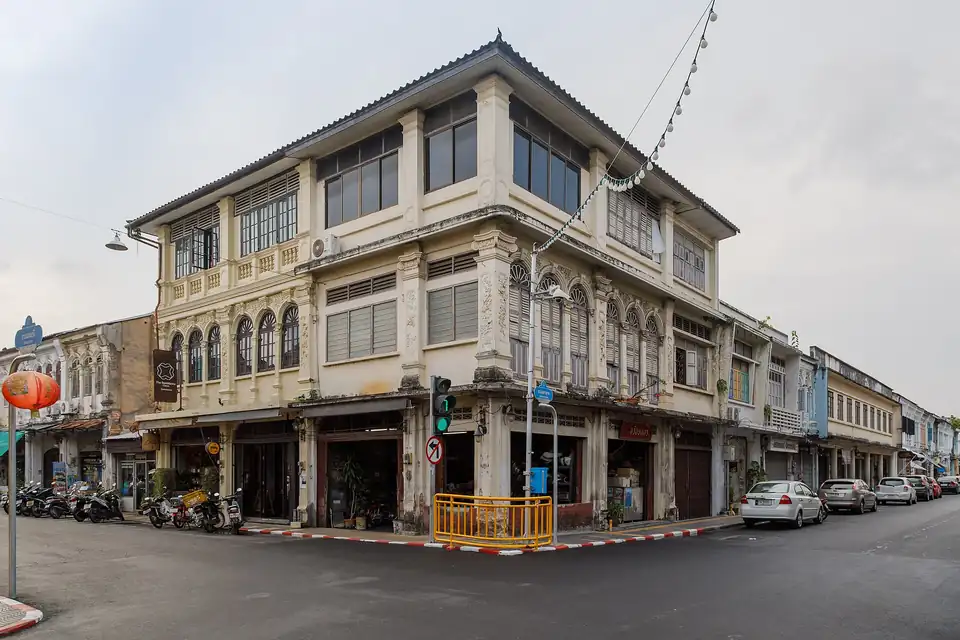
Phuket Old Town is the answer to a question most visitors do not think to ask, which is where the island’s money came from before tourists. It came from tin. The quarter that survives is what the mining families built with it: ten streets of shophouses in a style that arrived from Penang and Singapore along with the merchants and the builders who put them up.
It is roughly four kilometres from the nearest beach and it is the most interesting square kilometre on Phuket.
What Sino-Portuguese actually means
The term gets used as decoration and it describes something specific. A shophouse of this kind has a narrow front and considerable depth, one or two storeys, the trade on the ground floor and the family above. The front is arched windows and louvred shutters. At street level the upper floors overhang to make a continuous covered walkway, so a whole terrace of shops shares one arcade and a shopper can go the length of a street without stepping into the sun.
That last detail is the one that matters here, and we will come back to it.
The style is Straits Chinese rather than Thai, and it is the same family of building found in George Town and along the older streets of Singapore. It arrived with the tin trade in the nineteenth century: Hokkien Chinese labour and capital, colonial-influenced façades, Chinese plans behind them. Phuket City today is a working town of about seventy-one thousand people, and the heritage quarter is a small part of it, not a preserved site with a gate.
The case for the old town, from our own weather data
Every guide to Phuket puts the old town in the culture slot: something to do if you tire of the beach. That undersells it, and our own numbers say why.
Phuket’s southwest monsoon runs from May to October, and across those six months the island takes between 223mm and 315mm of rain in every single one. October has twenty-eight rain days out of thirty-one. During those months the west-coast beaches are also at their roughest, with wave heights above 1.3 metres and red flags up on the days that matter. Roughly half the year, in other words, the thing most people came for is unreliable.
The old town is the part of the island that does not care. The arcades are covered, the distances are short, the museums and the cafés are indoors, and heavy afternoon rain is an inconvenience rather than a cancelled day. If your trip falls in the wet half of the year, this is not the backup plan. It is the plan, and the beach is the thing you do when it happens to be dry. The weather page has the month-by-month figures and where they come from.
The Sunday walking street
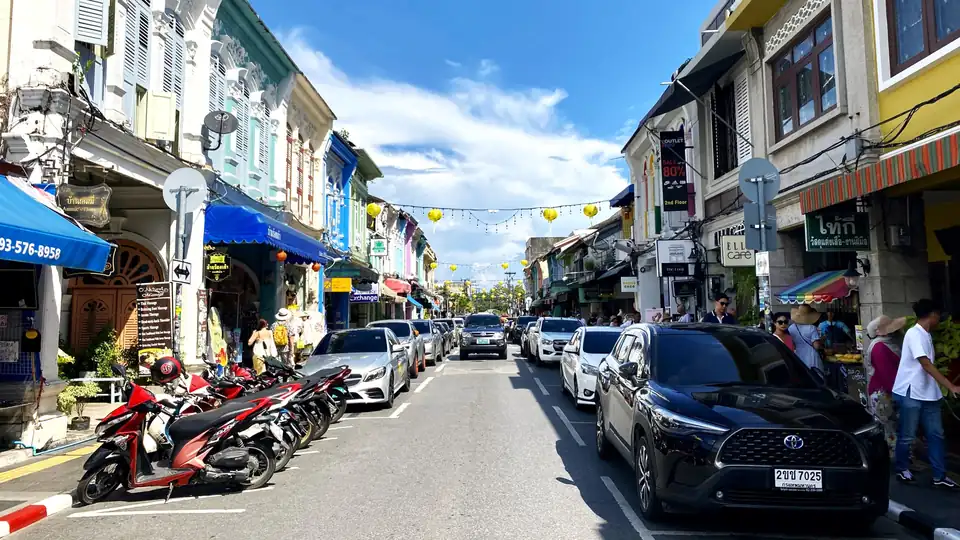
Thalang Road closes to traffic on Sunday afternoons and fills with stalls, food carts and a great many people. It runs from 4pm, and this is where we have to be honest: the sources disagree about the end. Some give 9pm, others 10pm. We have not been able to settle it from a source we would stand behind, so treat the last hour as uncertain and go earlier rather than later. By about 6pm the street is crowded enough that covering its kilometre takes considerably longer than it looks.
Whether it improves a visit depends on what you want from the streets. The buildings are the reason to come to the old town and the market puts a wall of stalls in front of them. If the architecture is the point, come on a weekday morning, when the photograph above was taken and the streets are close to empty. If the food and the crowd are the point, come on Sunday. Doing both means two visits, and the two visits are genuinely different places.
Eating here
The old town has the best food on Phuket and it is not close. The reason is the same as the reason for the architecture: this is a Hokkien Chinese town in southern Thailand, and the local dishes come out of that. Hokkien noodles, dim sum in the mornings, and the roti and Muslim-influenced cooking that the wider south does well. Prices are what Thais pay, which is a different economy from Patong.
Our Thai food guide covers the regional differences, and the where-to-stay guide treats the old town as one of the island’s four bases, which is the honest way to think about it: cheapest, best fed, no beach.
Getting here and what it pairs with
The old town is in Phuket City on the east side of the island, about forty minutes from Patong and a little less from Kata. Songthaews run from the beaches into town during the day and stop early; taxis and app cars run all evening, which is what most visitors use for a Sunday night.
It pairs naturally with the Big Buddha and Wat Chalong, which sit between the town and the southern beaches on the same road, and it is the obvious wet-weather substitute if the hilltop is closed or in cloud. More on the island: things to do in Phuket and the beaches, ranked by what they are for.
Tours & walks in Phuket Old Town
 Free cancellation
Phang Nga Bay Canoeing & James Bond Island Tour from Phuket
 Free cancellation
Phuket Thai Cooking Class with Market Tour Option
 Free cancellation
Southern Flavors Phuket Food Tour with 15+ Tastings
 Free cancellation
Phuket City Tour with Wat Chalong, Big Buddha & Famous Viewpoints
 Free cancellation
Hong by Starlight: Sea Cave Kayaking and Loy Krathong Floating
 Free cancellation
Phi Phi Islands Adventure Day Trip w/ Seaview Lunch by V. Marine
Phuket Old Town FAQs
Is Phuket Old Town worth visiting?+
Yes, and it is worth more than the half-day most itineraries give it. It is the only part of the island with a built history rather than a beachfront, the food is the best on Phuket and the cheapest, and it is the one place here that works in heavy rain. If a day of your trip falls in the monsoon, this is where to spend it.
When is the Sunday walking street in Phuket Old Town?+
Every Sunday on Thalang Road, from 4pm. Sources disagree about whether it runs to 9pm or 10pm, so do not plan the last hour of the evening around it. The stalls fill roughly a kilometre of street between Phuket Road and Yaowarat Road, and by about 6pm the crowd is dense enough that walking it takes real time.
What is Sino-Portuguese architecture?+
The shophouse style the tin merchants built in: a single or two-storey building with a narrow frontage and considerable depth, arched windows and louvred shutters above, and a covered walkway at street level running under the upper floors. It is the same family of building found in Penang and Singapore, which is where the money and the builders came from.
How long do you need in Phuket Old Town?+
Half a day to walk the streets and eat, a full day if you want the museums and a slower lunch, and a Sunday evening if the walking street is the draw. It is small: the heritage quarter is ten streets and you can cross it on foot in twenty minutes.
Is Phuket Old Town a good place to stay?+
It is the cheapest base on the island and the best one for food, and it is not a beach. Choose it if the island's history and eating interest you more than a morning swim, or as a first or last night. Our where-to-stay guide covers it alongside the three beach areas.