
Phuket
Nai Harn Beach
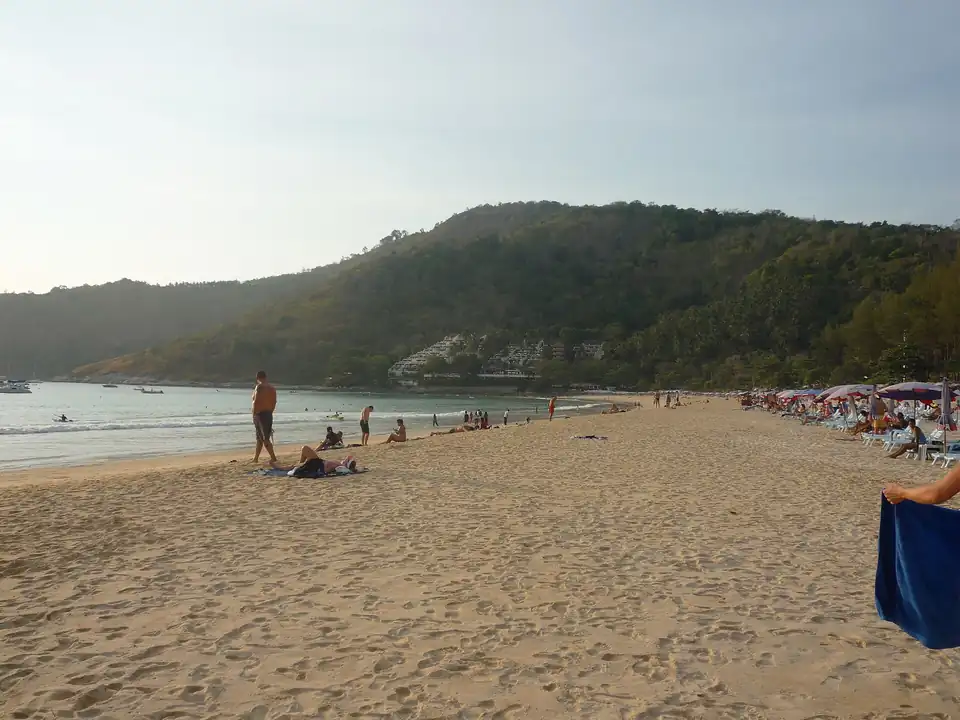
A near-complete bay at Phuket's southern tip, closed at both ends by headlands, with a freshwater lagoon behind the sand instead of a strip of shops. It is a yacht anchorage in the dry season and a wide empty beach in the wet one.
Nai Harn is the beach people photograph and then fail to describe, because what makes it work is an absence: there is no strip. A freshwater lagoon and a monastery sit behind the sand where Patong has three kilometres of bars, and two green headlands close the bay at either end. In the dry season yachts moor in the middle of it.
It is also, on our own figures, in the roughest of the five cells on this coast. Both of those things are true, and most guides mention only the first.
What the water actually does here
Nai Harn shares its marine grid cell with Kata and Rawai, so the three carry identical numbers: 0.61m in February at the calmest and 1.34m in July at the roughest. That is the highest dry-season figure on the west coast, about sixty per cent above Mai Khao and Nai Yang at the northern end of the island.
What the model cannot show is the shape of the shore. Nai Harn shelves steeply at its southern end and the shore break lands hard there when there is any swell running at all, which catches people out precisely because the bay looks enclosed and therefore safe. The lifeguards put the flags where they do for that reason.
Who it suits
People who want the beach to be the thing, and are content to drive to dinner. There are restaurants at the northern end and around the lagoon, and after that you are on a scooter or in a taxi. If you want to walk to a choice of places to eat, Kata is fifteen minutes north and is the better base.
It suits sunsets more than any other beach on the island, because it faces southwest into them rather than due west along the coast.
Getting here
About forty-five minutes from the airport and twenty from Kata, on a road that climbs and drops steeply at the end. Nai Harn is at the southern tip of Phuket, so it pairs naturally with Promthep Cape, Rawai and the pier for the offshore islands rather than with anything to the north.
open-meteo marine reanalysis, 2022 to 2025. Modelled sea state on a grid of about five kilometres, not surf at the shoreline. Nai Harn shares that cell with Kata and Rawai, so their figures are identical by construction rather than by separate measurement.
Nai Harn Beach in pictures
The rest of the coast
Every beach on this page is measured the same way, on the same scale, in Phuket’s beaches, ranked by what they are for. The month behind those figures is on the Phuket weather page, and where to base yourself is area by area.
Tours & boat trips from Phuket
 Free cancellation
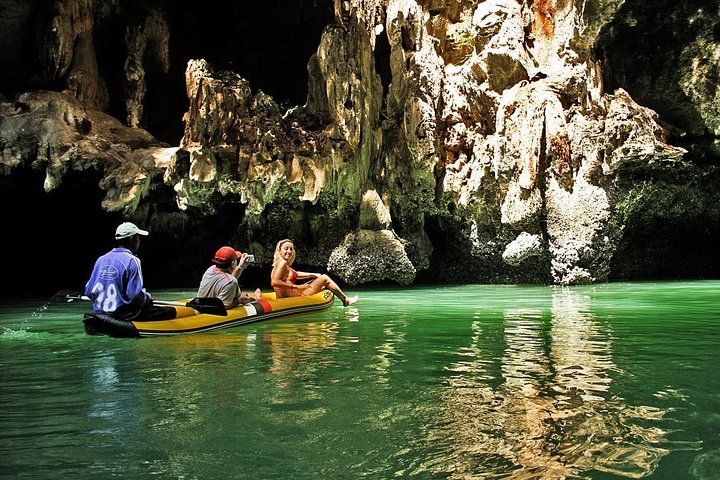
Phang Nga Bay Canoeing & James Bond Island Tour from Phuket
 Free cancellation
Phuket Thai Cooking Class with Market Tour Option
 Free cancellation
Southern Flavors Phuket Food Tour with 15+ Tastings
 Free cancellation
Phuket City Tour with Wat Chalong, Big Buddha & Famous Viewpoints
 Free cancellation
Hong by Starlight: Sea Cave Kayaking and Loy Krathong Floating
 Free cancellation
Phi Phi Islands Adventure Day Trip w/ Seaview Lunch by V. Marine
Nai Harn Beach FAQs
Is Nai Harn beach good for swimming?+
In the dry season, yes, and it is one of the most pleasant swims on Phuket. It is not a gentle beach in the monsoon: it sits in the same grid cell as Kata and Rawai, whose wave figures are the highest on the west coast at 1.34m in July, and it shelves steeply at the southern end. Swim between the flags and take the red ones seriously.
Is Nai Harn better than Kata?+
For looks, comfortably. For convenience, no. Kata has restaurants, dive shops and bars along its length and Nai Harn has a lagoon and a monastery. The two share their wave measurements exactly, so the sea is not the thing that separates them.
Are there hotels on Nai Harn beach?+
A small number set back from the sand rather than a strip along it, which is a consequence of the lagoon and the monastery occupying the land immediately behind. Our where-to-stay guide covers the island's four main bases and Nai Harn is not one of them.