

Krabi
Krabi Weather, Month by Month
Krabi is wetter than Phuket in eleven months of the twelve and its sea is between two and a half and three and a half times calmer in all twelve. Thirty years of rainfall and four of sea state, and what the combination means for when to come.
Most weather advice for the Andaman coast is written about Phuket and then applied to everywhere within a hundred kilometres of it. For Krabi that produces two errors at once, and they cancel out in a way that leaves people booking the wrong month for the wrong reason.
The first error is that Krabi is drier than Phuket. It is not. It rains more here in eleven months of the twelve. The second is that the two coasts have the same monsoon, which they do in the sky and do not at all in the water.
Krabi rains more and swims better
- Kata, Phuket
- Ao Nang, Railay and Phra Nang
- The figure under each month is how many times calmer Krabi is.
Krabi is calmer in all twelve months, and the gap is widest in December at 3.4 times and narrowest in April at 2.4. It widens through the monsoon rather than closing: in July, Kata averages 1.34m and Ao Nang 0.43m. And this is not because Krabi has better weather. It rains more here than on Phuket in 11 months of the twelve. The sea is the difference, and the reason is the map: these bays sit inside Phang Nga bay with the whole of Phuket island between them and the open Andaman.
What the rain actually does
Krabi’s dry run is December to March: 136mm, 61mm, 53mm and 112mm, with February the driest month of the year across only seven rain days. That is the high season and it is priced accordingly.
From April the totals climb and do not come down again until December. April is 185mm, May 255mm, and the run from May to November never drops below 241mm. October is the wettest month at 338mm across 28 rain days, which is more than Phuket’s own annual maximum of 315mm and more than Koh Samui’s 313mm in November.
What that does not mean is continuous grey. Twenty-eight days with rain out of thirty-one is a real figure, but most of it arrives as heavy afternoon downpours with sun on either side. The thing that genuinely changes a beach holiday is the sea, and here the sea barely changes at all.
The sea is the reason to come
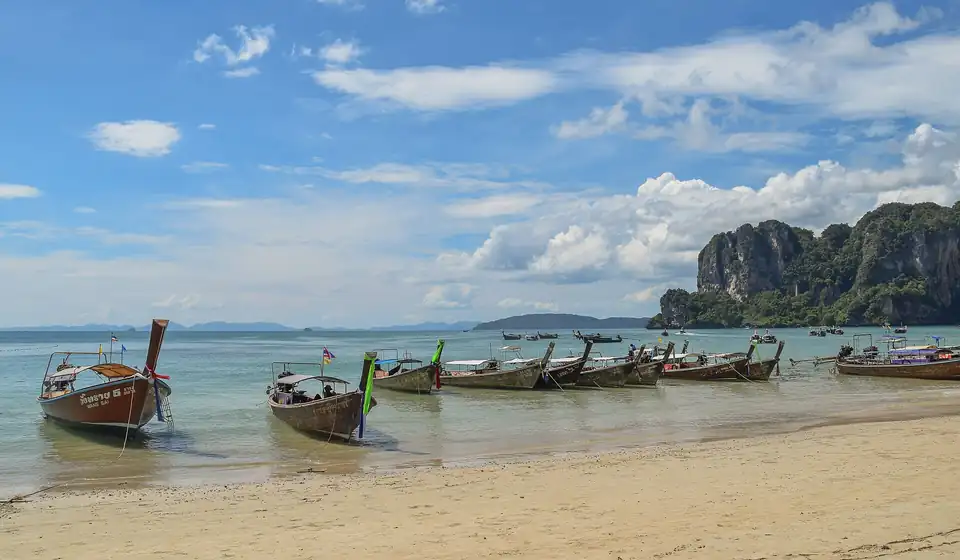
Ao Nang, Railay and Phra Nang measure between 0.18 and 0.43 metres of wave height across the entire year. The annual maximum, in July and September, is 0.43 metres. Kata on Phuket, ninety minutes away by road, reaches 1.34 metres in the same month.
The explanation is geography rather than weather. These bays face into Phang Nga bay with the whole of Phuket island sitting between them and the open Andaman, so the southwest monsoon arrives as rain but not as swell. It is why the red flags that close Phuket’s west coast for months at a time are a far rarer sight here, and why a July holiday in Krabi is a different proposition from a July holiday in Patong even though the rainfall figures are within twenty-five millimetres of each other.
Month by month
December to February is the best of the year on both counts: dry, and the calmest sea Krabi gets at 0.18 to 0.24 metres. December is the busiest and most expensive fortnight of the year from around the 20th, and February is the single best month.
March holds at 112mm and is the last of the dry run. The water is still under a quarter of a metre and the crowds have thinned from the Christmas peak.
April is the changeover, at 185mm across 24 rain days. Songkran falls on the 13th. It is hot, it is building, and it is the last month before the totals get serious.
May to September is the monsoon proper, between 241mm and 296mm a month. The sea rises to its annual maximum here, which is still only 0.43 metres. Prices are at their lowest and the province is at its emptiest, and this is the stretch where Krabi is a genuinely better idea than Phuket rather than merely a cheaper one.
October is the peak at 338mm. There is no dry coast anywhere in Thailand this month; Phuket takes 315mm and Koh Samui 270mm. If your dates are fixed to October, the sea here is one of the few consolations available, at 0.26 metres.
November is the recovery, still wet at 263mm but improving through the month, and the sea drops to 0.19 metres. Late November is often better than the totals suggest, and it is much cheaper than December.
Why there is no temperature on this page
Every other figure here is one we are prepared to defend, and temperature is not. The reanalysis grid cell covering Krabi is heavily influenced by water, which suppresses the modelled daily maximum below what a thermometer on the sand would read. Publishing it would mean publishing a number with a known bias, so we publish none and explain the gap instead.
It would not tell you much in any case. Krabi sits at about eight degrees north and has no cool season: it is hot in every month, and the difference between the warmest and the coolest is smaller than the difference between morning and afternoon. The month here decides the rain and the crowds, not the heat.
Choosing between the coasts
If your dates are fixed and the island is not, the two-coast comparison is set out in full on our month-by-month page, and the beaches themselves are compared on the Krabi beaches page. The short version: from December to March both Andaman and Gulf are dry and Krabi is at its best; from May to September the Gulf is the drier coast but Krabi is still the calmer water; and in October nowhere is working.
Krabi Weather, Month by Month FAQs
What is the best time to visit Krabi?+
December to March, and February is the pick of it at 53mm of rain across seven days. January and December are close behind. Those four months are dry, and they are also the calmest water of the year here, at around 0.18 to 0.24 metres of wave height.
When is the rainy season in Krabi?+
May to November, peaking in October at 338mm across 28 rain days. That is wetter than Phuket's own worst month. What it is not is unswimmable: Krabi's sea in October still averages 0.26 metres, against 0.88 off Kata on Phuket.
Is Krabi wetter than Phuket?+
Yes, in eleven months out of twelve, and it surprises most people. Krabi takes 338mm in October against Phuket's 315mm, and 247mm in July against 223mm. The reason to come here anyway is the sea, which is between two and a half and three and a half times calmer than Phuket's west coast in every month of the year.
Can you swim in Krabi during the monsoon?+
Usually, and this is the practical difference between the two sides of the Andaman coast. Ao Nang, Railay and Phra Nang never average more than about 0.43 metres of wave height in any month, because they sit inside Phang Nga bay with Phuket island between them and the open sea. Always read the flags, and treat a red one as absolute.
How hot is Krabi?+
Hot all year with very little seasonal swing, which is why this page carries no temperature figures. The reanalysis cell here is heavily influenced by water and suppresses the modelled daily maximum, so rather than publish a number we cannot defend we publish none and say why.