
Krabi
Krabi's Beaches: The Calmest Water in Thailand
The five calmest beaches this site measures anywhere in Thailand are all in Krabi, and the reason is a map rather than a season. Seven beaches compared on what the sea does, what is behind the sand, and which ones a road actually reaches.
Krabi’s beaches have a property that no amount of editorial can improve on, so this page starts with it: the five calmest beaches this site measures anywhere in Thailand are all in this province.
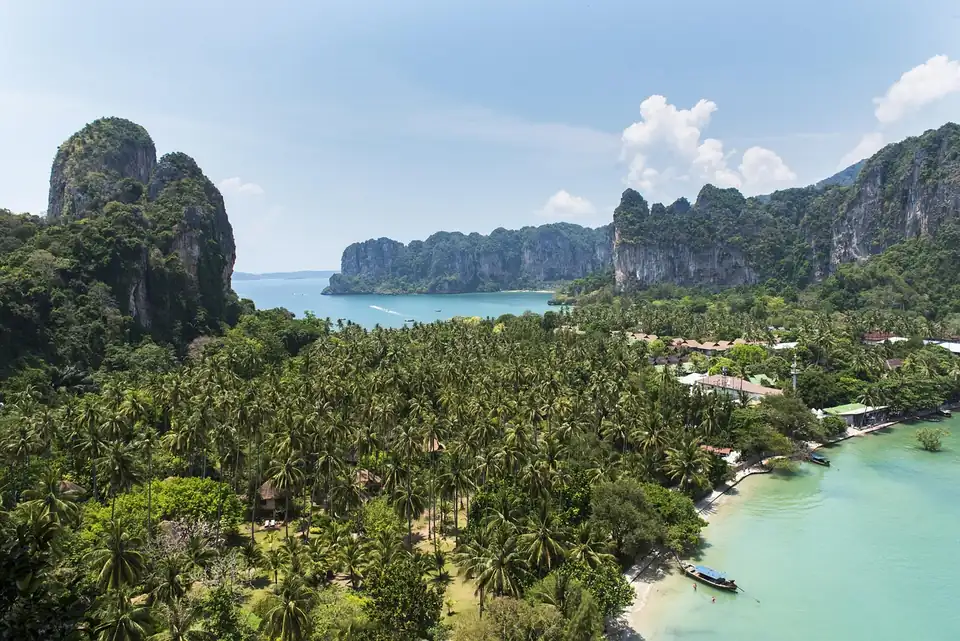
That is not a seasonal fact and it is not a lucky year. It holds in every month, and it comes from the map. The Ao Nang and Railay bays sit inside Phang Nga bay with the whole of Phuket island between them and the open Andaman, so the swell that arrives on Phuket’s west coast simply never gets here.
How much calmer, exactly
- Kata, Phuket
- Ao Nang, Railay and Phra Nang
- The figure under each month is how many times calmer Krabi is.
Krabi is calmer in all twelve months, and the gap is widest in December at 3.4 times and narrowest in April at 2.4. It widens through the monsoon rather than closing: in July, Kata averages 1.34m and Ao Nang 0.43m. And this is not because Krabi has better weather. It rains more here than on Phuket in 11 months of the twelve. The sea is the difference, and the reason is the map: these bays sit inside Phang Nga bay with the whole of Phuket island between them and the open Andaman.
What the measurements can and cannot separate
Two limits to state before the beaches, because they change how you should read the numbers below.
Five of these seven share one grid cell. Ao Nang, Railay West, Phra Nang, Tonsai and Ao Nam Mao all resolve to the same five-kilometre square of the marine model, so they carry identical figures rather than similar ones. Klong Muang and Tub Kaek share a second cell between them. That means a ranking of Krabi’s beaches by calmness would be inventing a precision the source does not have, and this page does not attempt one.
The one genuinely useful comparison is against another coast, not within this one. The gap between Krabi and Phuket is threefold and survives any reasonable doubt about the model. The gap between Railay and Klong Muang is a hundredth of a metre and does not.
So what separates these beaches is everything except the sea: whether a road reaches them, what is behind the sand, and how far the tide goes out.
The Railay peninsula
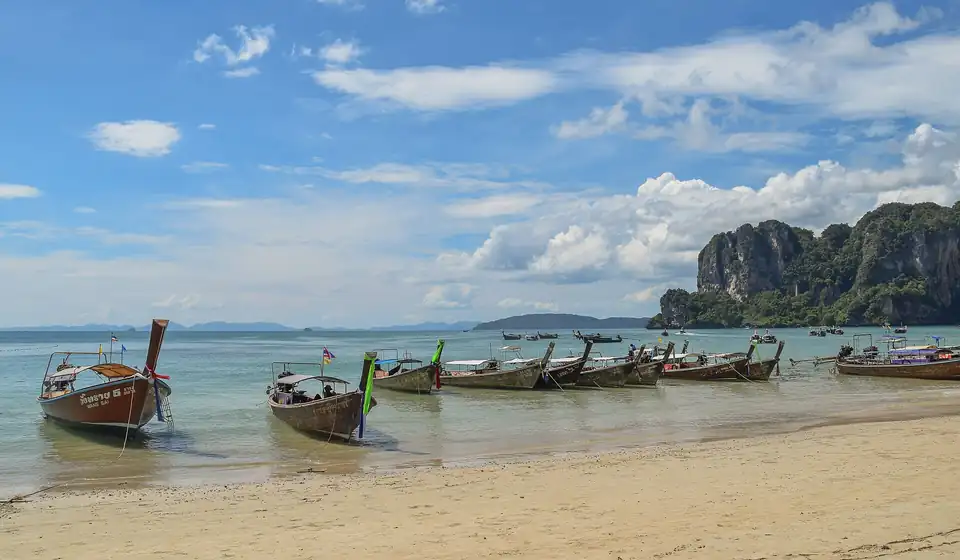
Railay West is the postcard: a short strip of sand with limestone walls closing it at both ends and longtails drawn up on it. There is no road onto the peninsula, so everything arrives by boat from Ao Nang or from Ao Nam Mao pier, a ten to fifteen minute crossing. That isolation is the whole appeal and it is also the whole drawback: it is either the most romantic place on this coast or too small by the fourth day, and both reactions are common.
Phra Nang is the cove at the tip, reached on foot from Railay through a passage under the cliff, and it is the single most photographed piece of sand in the country. It has an overhanging wall at one end, a cave shrine hung with offerings, and boats selling food off the water. It is not a place to stay; there is nothing on it. It is a place to walk to.
Tonsai, next to Railay West and reachable along the shore at low tide, is the climbers’ bay: cheaper, rougher around the edges, and with a different crowd. If Railay feels manicured, Tonsai is the reason people say Krabi used to be better.
Ao Nang
The base most people actually book, and the one with the restaurants. Ao Nang is a working resort town along a single seafront road, with the pier for Railay and the islands at one end and enough places to eat that no evening needs planning. The beach itself is the least remarkable in this list, and that is the trade: you are here for the convenience and for how easily everything else is reached from it.
Its measurement is identical to Railay’s, because it shares the cell. What it does not share is the quiet.
Klong Muang and Tub Kaek
Twenty minutes north of Ao Nang and a different province in feel. Klong Muang is a quiet resort strip facing open water towards Phuket, with a handful of large hotels and very little else. Tub Kaek beyond it is the northern end of the developed coast, under the Khao Ngon Nak ridge, and is the quietest sand in Krabi with a road to it.
These two carry the lowest annual maximum of any beach on this site, 0.42 metres against 0.43 for the Railay group, which is a difference of no practical consequence and is reported here only because leaving it out would be selective. What matters about them is that they are reachable by car, unlike Railay, and empty, unlike Ao Nang.
Ao Nam Mao, and why a wave figure is not a beach guide
Ao Nam Mao measures exactly as calm as Phra Nang. It is also not somewhere you would swim: it is the pier bay for Railay and the Hong islands, on a wide tidal flat that is more mud than sand and that goes a very long way out at low water.
We include it deliberately, because it is the clearest demonstration on this site of a rule that applies to every beach page we publish. A measurement tells you what the sea is doing. It does not tell you whether you want to be in it. The same point is made from the other direction on Phuket, where Mai Khao shares the calmest cell on that coast and is the one beach we will not recommend to families.
Which to choose
Railay West if the setting is the point and you are content to be somewhere small. Ao Nang for a first visit, a base and a choice of dinners. Tub Kaek or Klong Muang for quiet with a road, and for a resort you intend to use. Phra Nang is not a choice, it is a morning: go, early, before the boats arrive.
Where to actually book on each is on our Krabi where to stay page, the season that governs all of them is on the weather page, and the island trips that leave from these beaches are on things to do.
Krabi's Beaches: The Calmest Water in Thailand FAQs
Which is the best beach in Krabi?+
Phra Nang for the setting, and it is not close: a cove under an overhanging cliff at the end of the Railay peninsula, reachable only on foot from Railay or by boat. Railay West for staying on, Ao Nang if you want restaurants and a base, and Tub Kaek or Klong Muang if you want quiet with a road.
Is Railay a separate island?+
No, and it is the most common misunderstanding about Krabi. Railay is a peninsula attached to the mainland, but limestone walls cut it off by land, so there is no road onto it. Everything and everyone arrives by longtail from Ao Nang or from Ao Nam Mao pier, which takes about ten to fifteen minutes.
Which Krabi beach has the calmest water?+
Klong Muang and Tub Kaek by a hair, at 0.42 metres in their roughest month against 0.43 for the Ao Nang and Railay group. The honest answer is that the difference is inside the model's resolution: the whole province is exceptionally calm, and choosing between its beaches on wave height would be false precision.
Can you swim at Ao Nam Mao?+
Not really, and it is worth knowing before you book near it. Ao Nam Mao is the pier for Railay and the Hong islands, on a wide tidal flat that goes a long way out and is more mud than sand. Its wave measurement is identical to Railay's, which is a good demonstration of why a wave figure alone should never pick a beach.
Are Krabi's beaches better than Phuket's?+
Calmer, in every month of the year, by between two and a half and three and a half times. Ao Nang, Railay and Phra Nang never average more than 0.43 metres of wave height; Kata on Phuket reaches 1.34 in July. Phuket has more choice, more nightlife and far more flights.