
Khao Lak
Khao Lak Weather, Month by Month
Khao Lak has the most extreme year on the Andaman coast: 46mm in February and 400mm in September. It is wetter than Phuket in ten months of the twelve and calmer than it in all twelve, and the Similan Islands close for half the year.
Khao Lak has the most extreme year on the Andaman coast, and the two halves of it barely resemble each other. February takes 46mm of rain across eight days. September takes 400mm across twenty-seven. Only Koh Chang, on the eastern seaboard, is wetter anywhere on this site.
That is not a wet season in the way the phrase is usually used on this coast. It is the difference between a beach holiday and a different holiday, and it is the single thing to get right when booking here.
The year, against Phuket
- Rainfall, millimetres per month
- Phuket, for comparison
Driest is February at 46mm over 8 rain days, wettest is September at 400mm over 27 rain days. Against Phuket, Khao Lak is wetter in 10 months of the twelve, and the largest gap is in September.
Wetter than Phuket, and calmer than it
The comparison above is the useful one, because Phuket airport is eighty kilometres south and most people choosing Khao Lak are choosing it instead of Phuket.
Khao Lak is wetter in ten months of the twelve. In September it takes 400mm against Phuket’s 293mm, which is the largest gap of the year. Only November and December run the other way, and only just.
And it is calmer in all twelve. Four years of marine reanalysis put Nang Thong between 0.29 and 0.93 metres of wave height across the year, against 0.47 to 1.34 off Kata on Phuket’s west coast. In July, the roughest month on this coast, Khao Lak is running at about seventy per cent of Phuket’s swell.
That is the trade the two places represent, stated in figures rather than in atmosphere: more rain, better sea. It is also why the red flags that close Phuket’s beaches for weeks at a time are a less frequent sight here, though this is still an exposed west-facing coast and the flags mean the same thing when they go up.
The coast gets calmer as you go north
Khao Lak is thirty kilometres of beaches rather than one, and the sea is not the same along all of it. Nang Thong and Bang Niang at the southern end share a marine cell and peak at 0.93 metres in July. Khuk Khak and Pakarang, in the middle, run at 0.87. Bang Sak at the northern end is at 0.79.
That is a difference of about fifteen per cent between the two ends of the same coast, in the same month, and it holds in every month of the year. It is not large enough to change which beach you book, and it is worth knowing if calm water in the shoulder season is what you are after: north is flatter. The beaches are compared in full here.
The Similans decide the year
Everything above is climate. The reason it matters here more than at most Thai beaches is that Khao Lak’s principal draw is a national park that closes.
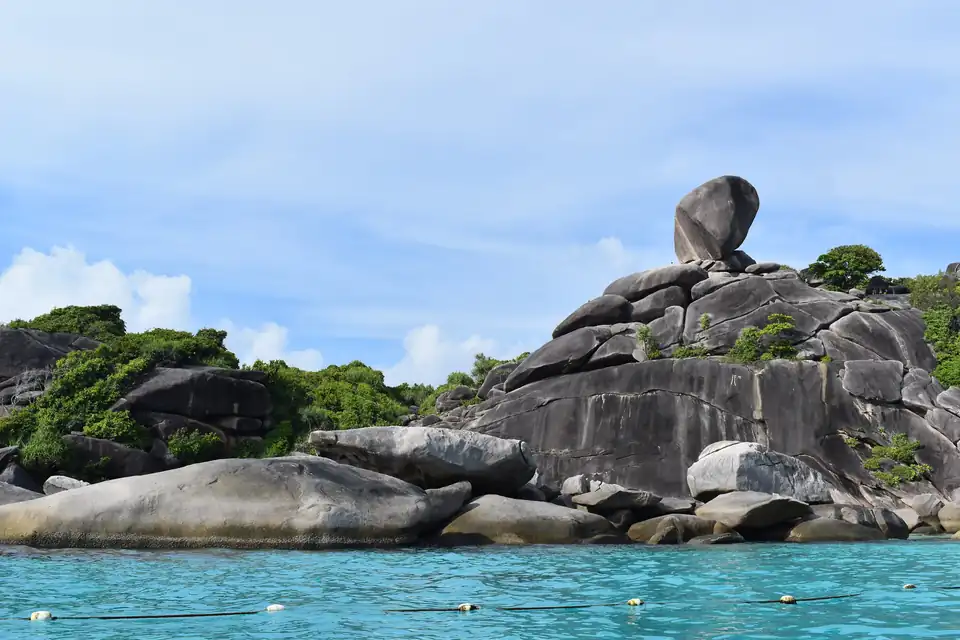
The Similan Islands, sixty kilometres offshore, shut for the monsoon, historically from around mid-May to mid-October, with the exact dates set each year by the park authority. When they are shut, the dive boats do not run, a good number of operators close entirely, and a proportion of the resorts follow. When they are open, Khao Lak is one of the best dive bases in the country.
So the Khao Lak season is not a preference, it is close to binary. If the Similans are why you are coming, check the year’s dates before booking anything, because a fortnight in early May and a fortnight in late May are different holidays.
Month by month
December to March is the season: 99mm, 69mm, 46mm and 122mm. February is the driest month and the best of the year on both counts, dry and calm at about 0.30 metres. This is also peak price, particularly from around 20 December to early January.
April is the transition at 168mm across twenty-two rain days, still largely fine and noticeably hotter. Songkran falls on the 13th.
May to October is the monsoon and it is relentless by Thai standards: 317mm, 323mm, 328mm, 350mm, 400mm, 374mm. There is no month in this run that is a quiet exception. The sea runs at its annual maximum, the Similans are shut for most of it, and prices are at their lowest for obvious reasons.
November is the recovery at 213mm, improving through the month, and it is the one month where Phuket is wetter than Khao Lak. Late November is often much better than the monthly total suggests and is considerably cheaper than December.
What this page does not tell you
Temperature, because we cannot defend the figure. The reanalysis cell covering this coast is heavily influenced by water and reports a daily maximum below what you would read on the sand. It would not tell you much anyway: it is hot in every month here and the range across the year is a couple of degrees.
And the exact Similan opening dates for any given season, which are announced by the park authority rather than by us and move. Check them directly before you book flights around them.
The rest of the coast is on the Khao Lak guide, the beaches on where to stay, and the two-coast comparison for the whole country on the month-by-month page.
Khao Lak Weather, Month by Month FAQs
What is the best time to visit Khao Lak?+
December to March, and February in particular at 46mm across eight rain days. That window is also the Similan Islands season, which is the reason most people come, and the two coincide exactly. Outside it Khao Lak is one of the wettest places in Thailand.
When is the rainy season in Khao Lak?+
May to October, and it is severe by any standard: six consecutive months above 300mm, peaking at 400mm in September. That is more rain than Phuket, Krabi or Koh Samui records in any month of their years. Many resorts and most dive operations close or scale back.
Is Khao Lak wetter than Phuket?+
Yes, in ten months out of twelve, and by a wide margin in the monsoon: 400mm against 293mm in September. It is also calmer than Phuket in all twelve months, which is the trade the two places represent. Khao Lak takes more rain and gives you a better sea.
Can you swim in Khao Lak in the monsoon?+
More often than on Phuket's west coast, which is the practical difference between them. Nang Thong peaks at 0.93 metres of wave height in July against 1.34 off Kata. Read the flags regardless: this is still an exposed west-facing coast in the southwest monsoon.
When are the Similan Islands open?+
The national park closes for the monsoon, historically from around mid-May to mid-October, and the exact dates are set each year by the park authority. Since the Similans are the main reason to be here, that closure effectively defines the Khao Lak season.
How hot is Khao Lak?+
Hot all year with very little variation, which is why this page publishes no temperature. The reanalysis cell here is heavily maritime and suppresses the modelled daily maximum, so we would rather leave the figure out and say why than print one we cannot defend.