

Guide
A Thailand Honeymoon: The Coast Your Wedding Date Chooses
A honeymoon's month is already set, and Thailand's two coasts keep opposite seasons. Every month measured against both, and which islands suit two.
Every other guide to a Thailand honeymoon starts by telling you when to go. That advice is written for a holiday, and a honeymoon is not one. It is the single trip in a life whose dates are already fixed, usually by a wedding chosen for a venue, a season at home, or an aunt’s diary, and never for the weather eight thousand kilometres away.
So this starts from the other end: you have a month, and the month has a right answer. Thailand keeps two coasts that run about three months out of step, and for almost any set of dates one of them is working and the other is in its monsoon. That choice is larger than the choice of hotel, and it is the one most couples make last.

The short version
November to March, go to the Andaman: Krabi, Koh Lanta, the quieter half of Phuket. April to September, cross to the Gulf: Koh Samui and the top of Koh Phangan. January, February and March are the only three months when both coasts are dry at the same time, and therefore the only ones in which a two-coast honeymoon makes any sense. October is the only month with no answer at all.
That is the whole decision. The panel below is the evidence for it, month by month, and it is our own measurement rather than a repeated claim.
Your wedding month, measured against both coasts
- January Either coastCalmest water Railay West 0.23m
Both coasts are dry and the Andaman's sea is at its flattest, which is the combination that does not come round again until next January.
- February Either coastCalmest water Railay West 0.24m
The best fortnight of the Thai year, and the figures are not close: 32mm on the Andaman is the driest month anywhere in the country.
- March Either coastCalmest water Railay West 0.20m
The last of the three shared months, and the only one where the Gulf is marginally the drier of the two. A two-coast honeymoon still works, and after this it does not.
- April GulfCalmest water Bophut 0.30m
The Andaman has turned and the crowds have not gone. Songkran falls on the 13th, which is either the best week of your life or the wrong week to be dragging a suitcase.
- May GulfCalmest water Bophut 0.29m
The southwest monsoon is in on the Andaman, at 269mm against the Gulf's 113. This is the month the swap starts paying for itself.
- June GulfCalmest water Bophut 0.29m
The Gulf is drier in June than the Andaman is in February, which is the fact that reframes the whole summer.
- July GulfCalmest water Bophut 0.36m
Peak northern-hemisphere honeymoon season and the widest gap in the year: Patong is running at 1.30m of wave, Chaweng at 0.36m.
- August GulfCalmest water Bophut 0.31m
Same picture as July and slightly worse on the Andaman. Anyone quoting you Phuket for an August honeymoon is quoting you a brochure.
- September GulfCalmest water Bophut 0.35m
The Andaman's second-wettest month at 293mm. The Gulf is still under 150mm and still calm, and it is the last clean month before both coasts go.
- October NeitherNowhere is working
The one month with no answer. Both coasts are above 250mm, there is no arrangement of islands that fixes it, and the honest advice is to go inland or move the dates.
- November AndamanCalmest water Railay West 0.19m
The reverse of what everyone assumes. Koh Samui takes 313mm in November, its wettest month of the year, while the Andaman is drying out. The coast that was right in August is the wrong one now.
- December AndamanCalmest water Railay West 0.18m
The Andaman is back and the Gulf is not: 103mm against 163mm, and Chaweng's sea is at its roughest of the year. Christmas and New Year are the most expensive fortnight on both coasts.
Where the year changes coast
What the panel shows, and what no amount of prose conveys as quickly, is that the year is not a scatter of good and bad months. It is three unbroken runs and one orphan: three shared months to start the year, six Gulf months, two Andaman months to end it, and October, which belongs to neither. The rail down the left edge is that shape. The coast is a calendar question rather than a taste one, and this is what the calendar looks like.
The first handover is in April. The Andaman crosses from 93mm in March to 152mm in April to 269mm in May, and it is not a gentle slope: the southwest monsoon arrives more like a switch. April is the last month you can still book Phuket or Krabi without gambling, and Songkran falls on the 13th, which is either the best week of your life or the worst possible week to be moving a suitcase between islands.
The second is in October and November, and it is the one that catches people out, because it runs backwards from what they have read. October is washed out on both coasts, 315mm on the Andaman and 270mm on the Gulf. Then in November the Andaman starts drying while Koh Samui records 313mm, its wettest month of the entire year. A couple who learned that the Gulf is the drier coast, which is perfectly true from May to September, and applied that to a November honeymoon, have it exactly backwards. This is the single most common expensive mistake in Thai honeymoon planning, and it is a calendar error rather than a taste one.
November to March: the Andaman
One thing to reconcile before the islands, because the panel above and this heading appear to disagree. The panel decides the coast on rainfall alone, and on rainfall January, February and March are a genuine tie: both coasts are dry. The sea is what breaks it. Through those three months Chaweng averages 0.58, 0.58 and 0.43 metres while the Krabi bays are at 0.23, 0.24 and 0.20, because the Gulf’s rough season is the northeast monsoon and it runs through the exact months the Andaman is at its flattest. So the rain says either and the water says Andaman, and for a honeymoon, where most of the point is being in the sea rather than looking at it, the water wins.
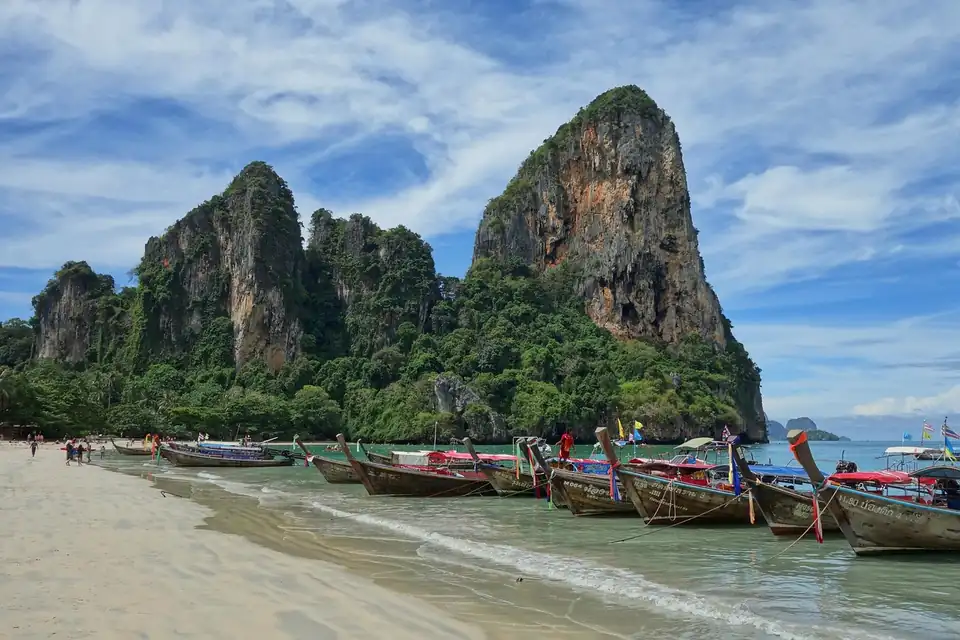
Krabi and Koh Lanta are the quiet end of this coast, and they are also, by our measurements, the calmest water in the country. Ao Nang, Railay and Phra Nang never average more than about 0.43 metres of wave height in any month of the year, because they sit inside Phang Nga bay with the whole of Phuket island between them and the open sea. Phuket’s own west coast reaches 1.34 metres in July. The three bays share a single five kilometre marine cell and therefore share one identical set of figures, which is worth knowing before you read too much into the decimal.
Railay is reached only by boat and is walled in by limestone, with no road on the peninsula at all. It is either the most romantic place on this coast or too small by the fourth day, and both reactions are common and neither is wrong. Koh Lanta is longer, has a road, and keeps its southern bays genuinely empty; Kantiang Bay is an hour of bad road from the pier, which is precisely why it is quiet.
Phuket’s northern beaches, Surin and Bang Tao, are the compromise most couples actually make: resort quality and a twenty minute airport transfer without going anywhere near Patong. It is the sensible choice and there is no shame in it, particularly if the flight has already eaten a day.
Khao Lak is the underrated one. An hour north of Phuket airport, resorts along a long straight beach, no nightlife to speak of, and the Similan Islands offshore between mid-October and mid-May. Nang Thong measures a third of a metre of wave in the winter months, less than half what Kata does.
Koh Phi Phi photographs better than it lives. Tonsai is loud and young, and the parts of the island that are not are a boat ride from everything, including dinner.
April to September: the Gulf

In these months the Gulf is not a fallback, and the figure that makes the point best is this one: the Gulf in June is drier than the Andaman in February. 85mm against 32mm is the wrong comparison, because February is exceptional; but 85mm in June against the Andaman’s 240mm in the same month is the comparison that matters, and it is close to threefold.
The sea agrees. Through July and August, Chaweng runs at about 0.36 and 0.31 metres while Patong is at 1.30 and 1.14. That is the difference between swimming and watching, and it is why an August honeymoon booked on Phuket is a brochure decision rather than a measured one.
Koh Samui’s north coast, Bophut and Maenam, is where couples go instead of Chaweng. Fisherman’s Village at Bophut has the restaurants without the strip, and the water is shallow and flat. Lamai, on the east coast, is the softer version of Chaweng and shares its shelter.
Koh Phangan’s north, and Thong Nai Pan in particular, is the quietest good option on this coast: two bays, a handful of hotels, a rough road in, and a long way from Haad Rin in every sense that matters. Koh Tao is the diving island, wonderful if you both dive and a slightly odd honeymoon if neither of you does.
One caution the brochures skip. The Gulf’s calm season is the summer, but its rough season is the winter: Chaweng averages 0.64 metres in December and 0.58 in January and February, its three roughest months, which are exactly the months a Christmas or Valentine’s honeymoon would land in. The Gulf in December is not the Gulf you were shown.
Both coasts in one trip: three months, or not at all
The two-coast honeymoon is the itinerary that looks best on paper and costs the most in practice. It works properly in January, February and March, and those are the only months both coasts are dry together. Outside them, half your fortnight is in a monsoon by arithmetic.
Even inside them it is a real journey rather than a hop. Phuket to Koh Samui is a crossing of the peninsula, not a move along a coast:
The full route page carries the timings and operators. Our advice, for a trip this short and this expensive, is to fly it or not to do it: the coach and ferry combination is a fine piece of travelling and a poor use of one of fourteen nights.
The better shape for most couples is one beach and one contrast. Three or four nights in Bangkok at the start gets you over the flight and gives the trip a change of gear, or three nights in Chiang Mai does the same thing with mountains instead of a city, and then a single beach for the rest. Two weeks split two ways reads as a holiday; split three ways it reads as an itinerary. If you want the longer version of that argument, our fortnight guide works through the routings in detail.
How long, and the shape of it
Ten to fourteen nights, and the flight is the reason. Eleven and a half hours nonstop from Heathrow, or about fourteen with a stop from anywhere else in Britain, plus a six or seven hour time difference. A week here spends two days of itself on the journey and a third recovering from it.
Fly overnight in both directions if you can. The evening departure from London lands in Bangkok in the afternoon, which puts you on a domestic connection the same day and on a beach for dinner. Coming back, the overnight suits a Monday morning less well but suits sleep considerably better.
One practical note that costs couples a day: if your passport name has changed after the wedding, the booking has to match the passport you actually travel on, not the one you will have in six weeks. Book in your current passport name. Thailand’s entry system is now the online Thailand Digital Arrival Card, and the name on it has to match too.
What the money actually buys

Thailand has the widest price range of any honeymoon destination at this flying distance, and that is its real advantage over the Maldives or the Caribbean rather than anything about the sand. The same stretch of beach carries a wooden hut and a villa with its own pool, and the distance between them in money is far smaller than the distance between them in comfort. The flight is the fixed cost that dominates a Thai honeymoon budget; almost everything after it is elastic, which means an upgrade here buys more than an upgrade almost anywhere else.
Two fortnights are the exception, and they are worth planning around. From roughly 20 December to the first week of January, and the week around Songkran in mid-April, rates reach their annual maximum on both coasts at once, and the better villas are gone months ahead. If your wedding date lands next to either, book early rather than well.
We do not quote nightly rates on this site, and the reason is not coyness. A price captured for a fixed window months ago is a number you cannot reproduce when you go to book, and it is worse than no number because it sets an expectation. Where we do give figures, they carry the date they were checked.
Getting married here, as opposed to honeymooning here
These are two different projects and they are worth keeping apart in your head. A symbolic beach ceremony is something resorts arrange as a matter of routine, and it is straightforward: you choose a time, they do the rest, and nothing legal happens.
A legally recognised Thai marriage is a different exercise. It runs through your embassy in Bangkok for an affirmation of freedom to marry, then certified translation, then a district office (amphur), and it wants months of lead time rather than weeks. A great many couples resolve this by marrying at home in a registry office and holding the ceremony they actually care about here, which removes the paperwork from the honeymoon entirely and is the version we would suggest to anyone whose dates are already tight.
If your month is October
It is the one case where the honest answer is to change something. October has no working coast: 315mm on the Andaman, 270mm on the Gulf, and no arrangement of islands that fixes it, because the two systems overlap rather than alternate that month.
Three ways out, in the order we would try them. Move the dates by two weeks, since the first days of November are already improving on the Andaman while late October is not. Go north instead, where Chiang Mai and Pai are past their own wet season by mid-October and the mountains are green in a way they are not in February. Or accept a beach with rain in it and book somewhere with a pool villa and a good restaurant, which is a genuinely reasonable choice for a honeymoon and a bad one for a beach holiday, and know the difference before you book rather than after.
What we would not do is book Phuket in October on the strength of a photograph taken in February.
Frequently asked questions
When is the best time for a Thailand honeymoon?+
February is the best month in the country: 32mm of rain on the Andaman coast, the driest figure of the Thai year. But a honeymoon follows a wedding date chosen for other reasons, so the practical question is which coast your month sends you to. January, February and March are the only three months when both coasts are dry at once. October is the only month when neither is.
Which Thai island is best for a honeymoon?+
It depends entirely on the month. From November to March, the Krabi coast: Railay and Phra Nang average 0.18 to 0.24 metres of wave height in those months, the calmest water of any beach we measure. From April to September, Koh Samui's north shore and the top of Koh Phangan, where the sea runs under 0.4 metres while Phuket's west coast is above 1.2.
How long should a Thailand honeymoon be?+
Ten to fourteen nights, and two places at most. The flight is eleven and a half hours nonstop from Heathrow, which makes a week hard to justify and a fortnight easy. Adding a third stop is what turns a honeymoon back into travelling.
Can we visit both coasts on a Thailand honeymoon?+
Only in January, February or March, which are the only months both coasts are dry at the same time. Outside them one of the two is in its monsoon. Phuket to Koh Samui is a 55 minute flight on the one airline that flies it, or six to ten hours by coach and ferry across the peninsula.
Is Thailand expensive for a honeymoon?+
It has the widest price range of any destination at this distance: the same stretch of sand carries a beach hut and a pool villa, and the gap between them is smaller than in the Maldives or the Caribbean. The flight is the fixed cost that dominates. The two expensive fortnights are Christmas to New Year and the week around Songkran in mid-April.
Can we get married in Thailand?+
Yes, and many couples do, though a legally recognised Thai marriage involves your embassy, an affirmation of freedom to marry, certified translation and a district office, and it wants months rather than weeks. Resorts arrange symbolic beach ceremonies routinely, and many couples marry at home and hold the ceremony here, which removes the paperwork entirely.