
Pai
Pai Canyon: What It Is, When to Go, and Where People Get Hurt
Eight kilometres south of town, a set of eroded earth ridges with drops on both sides and no railings once you leave the first stretch. What it actually is, when the light is worth timing, and the specific thing that goes wrong here.
Pai Canyon is the one thing near Pai that is genuinely worth putting in the diary at a specific time, and it is also the one that most needs saying plainly rather than photographing prettily.
What it actually is
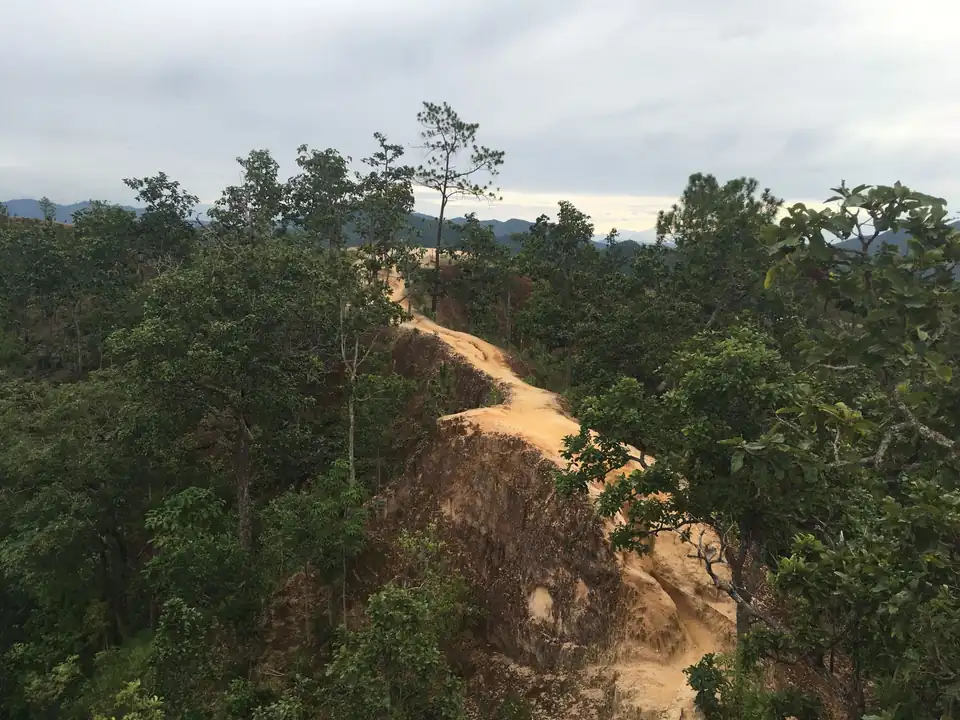
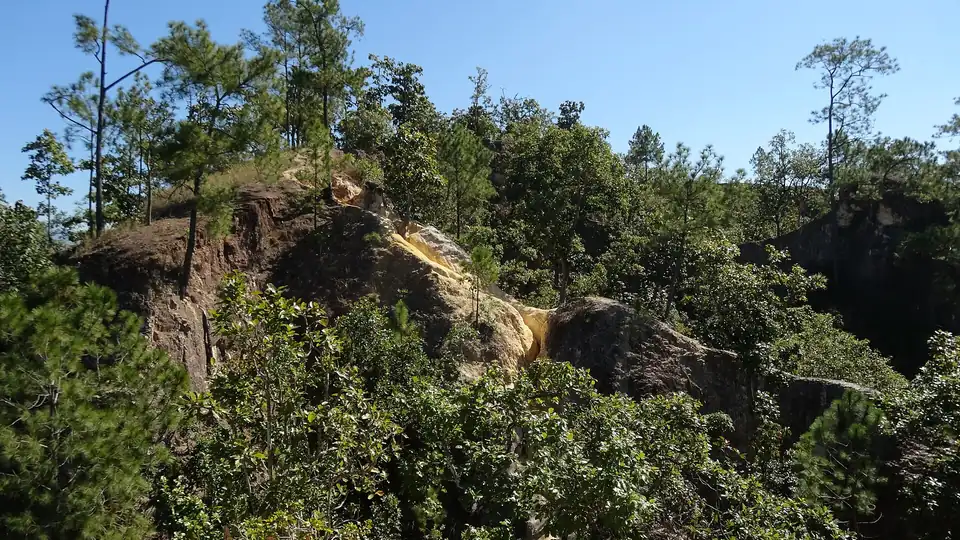
Not a canyon in the sense anyone arrives expecting. Kong Lan, its Thai name, is a network of narrow eroded ridges of red and ochre earth, a few metres wide in places and a good deal less in others, with drops on both sides and pine forest growing out of the tops. It sits about eight kilometres south of Pai on Route 1095, ten to fifteen minutes by scooter, with a car park at the entrance.
An hour covers it. The first stretch from the car park is straightforward and gets you to the viewpoints most people photograph. Everything beyond that is the ridge walk, and the ridge walk is the part this page is about.
The viewpoint and the ridges are two different visits
Most of what people come for is visible from the first viewpoint. You do not have to walk out along the ridges to see the valley at sunset, and nobody should feel they have missed the place by stopping there.
The ridges are the optional part, and they are a different proposition: narrow, unfenced, loose underfoot and slower coming back than going out. If you are bringing small children, if heights bother you, or if it has rained, the first viewpoint is the visit. If you do go further, go while there is still light to come back by.
Why sunset, and what that means in practice
Go about an hour before the sun goes down. The earth here is at its best in low light, the heat has come off, and the view west over the valley is the reason the place has a reputation at all. This is not a subtle preference: at noon it is a hot brown gully, and in the last hour of light it is worth the ride.
The consequence, and it is the whole safety problem in one sentence: everybody walks back in the dark. The crowd that came out along the ridges for the sunset returns along the same ridges twenty minutes later with no light, frequently on a phone torch, often after a beer, and sometimes in sandals. Bring a proper torch and start back before you have to.
The drops
There are no railings once you are past the first section, and there is no reason to expect any. This is not a maintained attraction in the western sense; it is a piece of terrain with a car park.
Three specific things about the ground itself, because “be careful” is useless advice:
It is earth, not rock. The ridges are what erosion has left standing, and erosion has not finished with them. In August 2017 a visitor fell about ten metres when, according to the authorities, part of the cliff came loose beneath her. An edge that looks solid is not a promise, and it is worse after rain.
The narrow sections are narrow. In places the walkable top is under a metre wide with several metres of near-vertical drop on both sides. There is no margin for stepping aside to let someone past, which is exactly what people try to do when the ridge is busy at sunset.
The descents are steeper than they look from above. Several routes down between ridges are effectively scrambles on loose ground. Going down is the easy half; people get stuck on the way back up.
People fall here. Besides the 2017 case, in July 2024 a 25-year-old British visitor fell five metres from a viewpoint early in the morning, so this is not only a sunset problem. Both got away with minor injuries, which is luck rather than a description of the risk. We are not going to dress that up, and we are not going to tell you to skip it either: stay back from edges, do not step backwards for a photograph, and treat any section that makes you hesitate as the end of your walk.
What to bring
Shoes with a grip rather than sandals. A torch, not a phone. Water of your own, rather than counting on buying some. And a plan to be off the ridges before it is properly dark rather than at the moment it becomes so.
Fitting it into a day
The canyon is the last stop rather than the first. Most people do it on the same scooter loop as the hot springs and a waterfall, ending here for the light, then riding the eight kilometres back into town for the night market. That ride back is in the dark on a road with no lighting, which is worth knowing before you plan it that way, and it is the argument for going as a passenger if you are at all unsure on a bike.
The rest of the valley, the road in from Chiang Mai and the months worth coming in are on our Pai guide.
Pai Canyon FAQs
Is Pai Canyon worth visiting?+
Yes, for the last hour of daylight, and it takes about an hour. It is not a canyon in the Arizona sense and anyone arriving expecting one will be disappointed: it is a network of narrow eroded earth ridges a few metres wide with drops either side, in pine forest, about eight kilometres south of Pai.
How dangerous is Pai Canyon?+
The first stretch is easy. Beyond it the paths narrow to ridges with unfenced drops on both sides, and the ground is eroded earth rather than rock, so edges can give way. People do fall here: in 2017 a visitor dropped about ten metres when part of an edge broke away, and in 2024 a man fell five metres from a viewpoint and needed a two-hour rescue. Both were lucky to escape with minor injuries. It is not a place to be casual near the edge, to walk out on in the dark, or to attempt in flip-flops after a drink.
What time should you go to Pai Canyon?+
Arrive about an hour before sunset. The light on the ochre earth is the point and the temperature is bearable by then. Bring a torch: the crowd walks back along the ridges in near darkness, and that walk is the part to plan for.
How do you get to Pai Canyon?+
It is about eight kilometres south of Pai on Route 1095, ten to fifteen minutes on a scooter, and there is a car park at the entrance. Most people ride there. If you are not confident on a scooter, this is a short and easy run compared with anything else around Pai.
Is there an entrance fee for Pai Canyon?+
We have not been able to confirm a current charge for entry or for parking, and we do not publish a figure we cannot stand behind. Carry some small notes and you will be covered either way.