
Bangkok
The Grand Palace
The walled complex Rama I built in 1782 and the home of the Emerald Buddha. What is open to visitors, the dress code that turns people away, and when to go.
The Grand Palace is the walled complex in Rattanakosin, Bangkok’s old royal island, that King Rama I built as his new capital’s seat of power in 1782. It served as the official residence of the Kings of Thailand for generations and still holds Wat Phra Kaew, which holds the country’s most revered Buddha figure. Most of the palace buildings you walk past today are closed to visitors: what you actually tour is the temple, the outer ceremonial halls, and the grounds around them.
Why Rama I built it here
When King Rama I founded the Chakri dynasty in 1782, he moved the capital across the Chao Phraya from Thonburi to Bangkok and laid out a new palace on the river’s east bank, modelled in spirit on the lost royal complex at Ayutthaya. The Grand Palace grew over the following reigns, with each king adding halls, gates, and residences, so that what stands today is less a single building than a walled town of throne halls, offices, and one working royal temple. The monarchy no longer lives here day to day, but the palace still hosts state ceremonies and remains the formal seat of the Thai crown.
Wat Phra Kaew and the Emerald Buddha
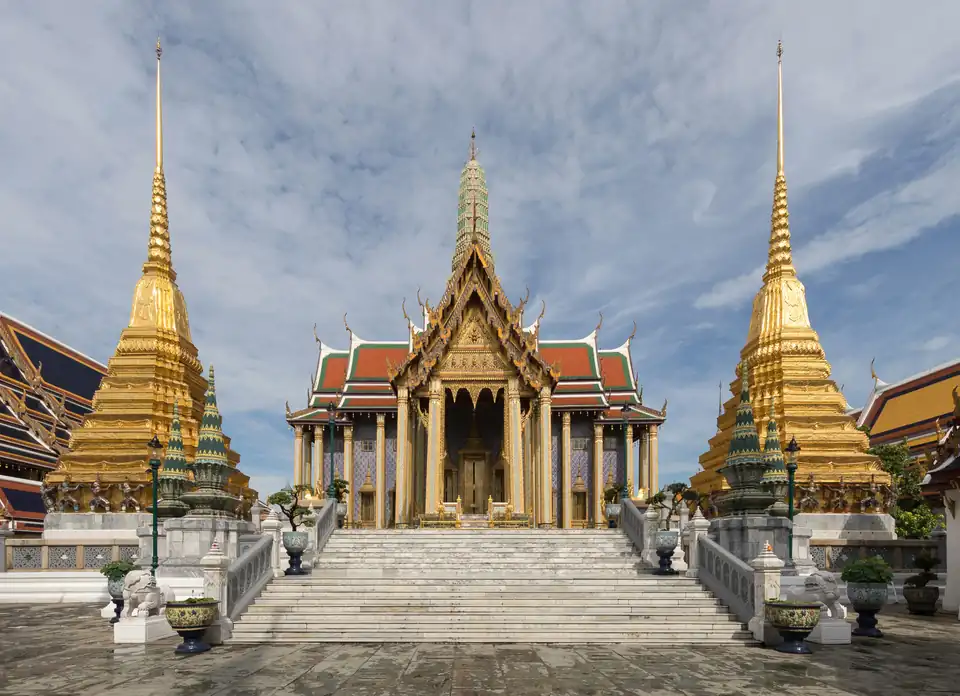
Inside the palace walls sits Wat Phra Kaew, the Temple of the Emerald Buddha, and it is the reason most people come. The Buddha figure itself is small, carved from a single block of green jade rather than emerald despite the name, and it sits high on a gilded altar under a multi-tiered umbrella canopy. Thai kings have changed its ceremonial robes at the turn of each season for centuries, a ritual the current monarch still performs. Unusually for a major Bangkok temple, no monks live at Wat Phra Kaew: it functions as a royal chapel rather than an active monastery, which is part of why the atmosphere inside feels more formal than at Wat Pho or Wat Arun.
What else is worth slowing down for
Beyond the main temple, the complex is worth a slower walk. The cloister running around Wat Phra Kaew has murals depicting the Ramakien, the Thai retelling of the Ramayana, painted and repainted across two centuries. The Chakri Maha Prasat throne hall mixes a Thai-style multi-tiered roof onto a European colonial facade, a combination that tells you a lot about how the 19th-century monarchy positioned itself between tradition and the wider world. Guardian statues, gilded chedis, and mother-of-pearl doors are worth pausing for rather than rushing past on the way to the next landmark.
Dress code and etiquette
The dress code here is enforced more strictly than almost anywhere else in Bangkok. Shoulders and knees need to be covered, and see-through fabric, vests, and torn or overly casual clothing will get you turned away or asked to cover up at the gate. Bring a scarf or a light long-sleeve layer if you are travelling in shorts or a tank top; staff at the entrance can supply a sarong or wrap if you arrive without one, though queuing for a loan is slower than just packing your own. Shoes come off before entering the temple buildings themselves, and visitors are asked to stay quiet and keep gestures respectful around the Emerald Buddha, since this is an active place of royal worship, not a museum piece.
One thing worth planning around
The Grand Palace can close to the public without much warning for state or royal ceremonies. If your visit dates matter, check the official site the day before rather than assuming the schedule you saw weeks ago still holds.
Getting there
MRT Sanam Chai on the Blue Line is the closest station, a walk of around ten to fifteen minutes from the palace gates. Coming by river, the Chao Phraya Express Boat stops at Tha Chang pier, a short walk from the entrance and an easy way to arrive if you are already exploring the riverside. Traffic around Rattanakosin gets heavy by mid-morning, so a taxi or ride-hailing app works fine early but loses most of its advantage later in the day.
Nearby: Wat Pho and Wat Arun
The Grand Palace sits within easy walking distance of Wat Pho, with its reclining Buddha, and most visitors pair the two on the same morning. Across the river, Wat Arun, the Temple of Dawn, is a short cross-river ferry from the Tha Tien pier near Wat Pho and makes a natural third stop, especially in the softer light of late afternoon. Doing all three in one day is common, but it is a long day in the heat, and the Grand Palace alone deserves the unhurried half you can give it if you go early.
Planning a Bangkok temple day
See how the Grand Palace fits alongside Wat Pho, Wat Arun, and the rest of the city’s landmarks.
Tours & tickets near The Grand Palace
 Free cancellation
Bangkok Canal Tour: 2-Hour Longtail Boat Ride
 Free cancellation
Half-Day Floating Market and Railway Market Tour from Bangkok
 Free cancellation
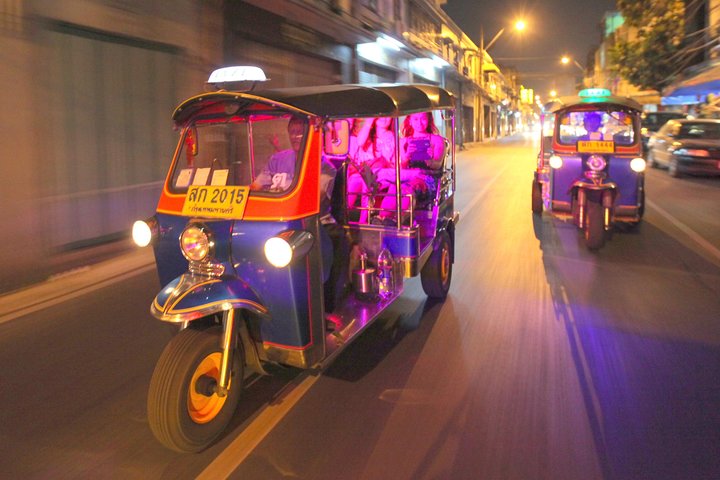
Bangkok by Night: Temples, Markets and Food Tuk-Tuk Tour
 Free cancellation
Bangkok Backstreets Food Tour with 15+ Tastings
 Free cancellation
UNESCO's Ayutthaya Historical Park: Full-Day Tour from Bangkok
 Free cancellation
Grand Palace & Temples of Bangkok with experienced guide
The Grand Palace FAQs
Can I visit the Grand Palace without covering my shoulders and knees?+
No. The dress code is checked at the entrance and enforced consistently, for men and women alike. Bring your own cover-up rather than relying on rental sarongs at the gate.
Is the King still living at the Grand Palace?+
No, the Thai monarchy resides elsewhere now. The palace remains the ceremonial and symbolic seat of the crown and is used for state occasions, while most of its historic buildings stay closed to the public.
How long should I plan for a visit?+
Most visitors need two to three hours to see Wat Phra Kaew and the open palace grounds without rushing. Arriving near opening time makes a real difference, since the site gets crowded and hot by late morning.
Should I visit the Grand Palace or Wat Pho first?+
Either order works, since they sit close together. Many visitors start at the Grand Palace while it is cooler and less crowded, then walk to Wat Pho afterwards.