
Bangkok
Getting Around Bangkok
Bangkok runs on two networks that barely overlap: the BTS and MRT for the new city, the river and canals for the old one. Which serves where, and what it costs.
Bangkok runs on two transport systems that barely overlap. The BTS Skytrain and MRT cover the newer commercial city fast and reliably, but they do not reach most of the Old City temples. The Chao Phraya river and its canals do reach them, and are often the quicker route once you account for traffic. Knowing which network serves which part of the city, rather than defaulting to a taxi for every trip, is the difference between an efficient day and an afternoon stuck in gridlock.
How the networks fit together
BTS Skytrain
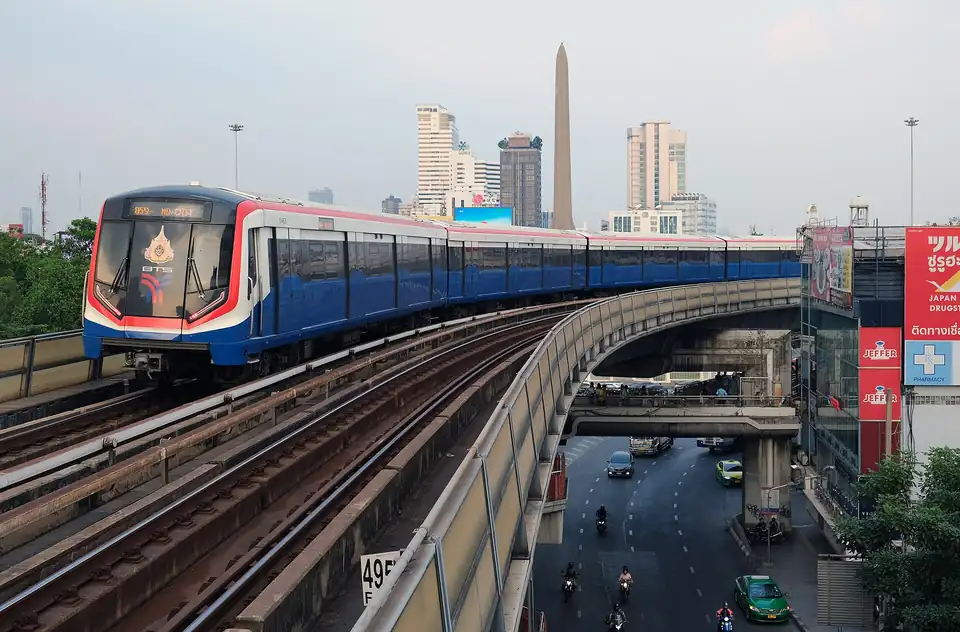
The BTS runs on two lines, Sukhumvit and Silom, crossing at Siam and covering the part of Bangkok most visitors spend their time in: the shopping centres around Siam and Chit Lom, the Sukhumvit hotel strip, and the Silom business district. Trains run frequently, and because the system is elevated, journeys are unaffected by the traffic below. A stored-value Rabbit card is worth buying on your first day if you are staying more than a couple of days; it saves queuing at the ticket machines. The northern end of the Sukhumvit Line reaches Mo Chit, the stop for Chatuchak Weekend Market.
MRT
The MRT subway fills in where the BTS doesn’t reach. The Blue Line loops south toward the river and the Old City, with interchange stations connecting back onto the BTS at points like Asok and Sukhumvit. An extension put a station near Wat Mangkon, bringing Chinatown within easy reach of the rail network rather than requiring a taxi or a long walk from the river piers. Ticketing works much like the BTS: single tokens or a stored-value card, bought at the station.
Chao Phraya river boats and canal boats
The river is the most direct route to most of Rattanakosin, the Old City island where the Grand Palace and the great temples stand, and usually the cheapest way to get there too. The Chao Phraya Express Boat runs a fixed set of piers on a public timetable, while a separate tourist boat loops between the main sightseeing piers with commentary and a slightly higher fare. For temple-hopping, Tha Tien pier serves both Wat Pho and the cross-river ferry to Wat Arun; Tha Chang is closer to the Grand Palace. Away from the main river, canal boats on the Khlong Saen Saep line run inland and are a fast, if crowded, way to reach the Phra Athit area near Khao San Road. Piers are not always clearly signed in English, so allow a few extra minutes to find the right one.
Taxis
Metered taxis are inexpensive when the meter actually runs, which is the main thing to insist on before getting in. Drivers waiting outside major tourist sites sometimes quote a flat fare instead or claim the meter is broken; if that happens, walking a short distance to hail a different cab usually beats arguing. Traffic, not price, is the real limitation: during rush hour a short trip can take far longer by road than the same distance by BTS, MRT or boat, and the fare climbs with the time spent sitting still.
Grab and ride-hailing apps
Grab is the dominant ride-hailing app in Bangkok: a fixed fare is shown before you confirm, the driver’s route and vehicle are displayed, and there’s no meter dispute to worry about. It typically costs a little more than a fairly metered taxi, but removes the two most common taxi frustrations, refusal and haggling, making it a solid default after dark or wherever hailing a cab on the street is difficult.
Tuk-tuks and motorbike taxis
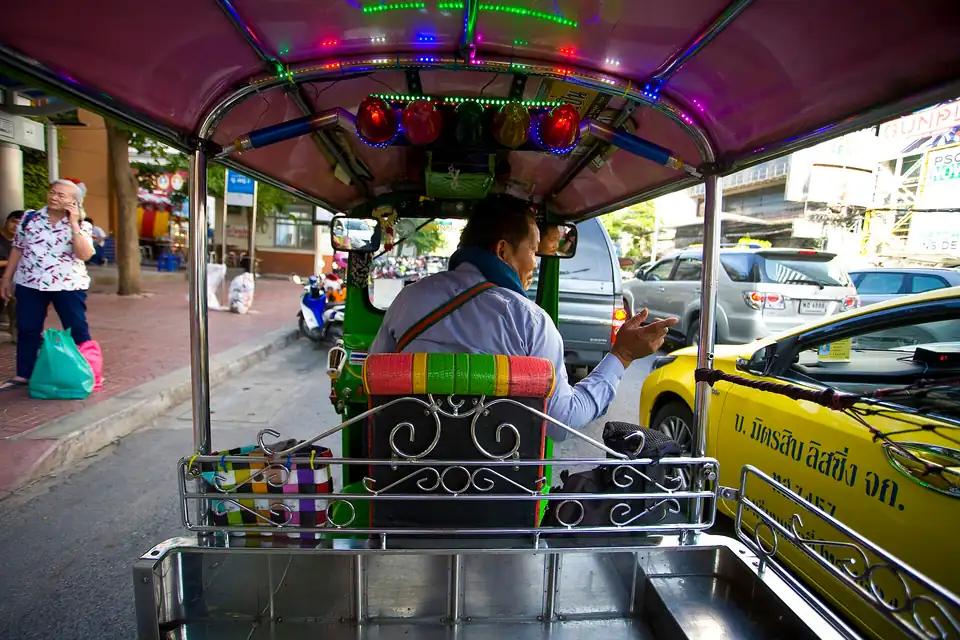
Tuk-tuks suit a short novelty ride more than practical transport; agree the price before getting in, since there is no meter, and expect to pay more than a taxi for the same trip. Motorbike taxis are the opposite: a genuinely useful way to beat traffic for a short hop, ridden by drivers waiting at stands marked by numbered vests near BTS stations, markets and busy sois. Agree the fare first, and a helmet should be offered; if it isn’t, use a different stand.
Getting from the airports
Suvarnabhumi Airport connects to the city by the Airport Rail Link, running into central Bangkok and linking up with the BTS and MRT, which makes it the most predictable option when traffic is bad. Don Mueang, used mainly by low-cost carriers, has no rail link and is reached by airport bus or taxi instead; a taxi from either airport should run on the meter plus the standard airport surcharge and tolls. At either airport, skip unofficial touts inside the terminal and use the official taxi rank or a pre-booked Grab.
Practical notes
Get a Rabbit card on your first BTS trip if you are staying more than a day or two; it is sold and topped up at station counters and saves time at the ticket machines. Plan around rush hour where you can: if a trip can be done by BTS, MRT or river boat instead of by road between roughly 7 and 9am or 4 and 7pm, take it. Be wary of anyone near a temple or the Grand Palace who says an attraction is “closed today” and offers to take you somewhere else, or who steers you toward an overpriced jewellery or tailor shop: these are long-running scams aimed at tourists, and the attraction is almost always open as normal.
Plan the rest of your Bangkok trip
See how the transport network connects to the sights worth building a route around, or start with where to base yourself.
Getting Around Bangkok FAQs
What's the cheapest way to get around Bangkok?+
River boats and the MRT/BTS are the cheapest options for most trips, and walking covers plenty of ground within districts like Silom or the Old City. Taxis and Grab cost more but remain reasonable for short trips, especially split between two or more people.
Is the BTS enough on its own, or do I need other transport too?+
The BTS alone covers Sukhumvit, Silom and Chatuchak well, but it does not reach the Old City temples, Chinatown's older lanes, or Khao San Road. Most visitors end up combining the BTS with the MRT, river boats and the occasional taxi or Grab, rather than relying on one system for the whole trip.
Should I take a taxi or use Grab?+
Both work; the choice comes down to certainty. A metered taxi is cheap if the driver runs the meter, but refusals happen near tourist areas. Grab shows the fare upfront and removes that uncertainty, which makes it the more reliable pick after dark or when hailing a cab on the street isn't easy.
What's the best way from the airport into the city?+
From Suvarnabhumi, the Airport Rail Link into town is fast and avoids traffic entirely, connecting onward to the BTS and MRT. From Don Mueang, an airport bus or a metered taxi/Grab is the only option, since there is no direct rail link; either way, book or queue at the official rank rather than accept an offer inside the terminal.